
Talent and career management software that grows your next leaders from within
Map the skills every role needs. Show people where they can go next. Know who is ready to step up before a resignation letter lands on your desk.
Quick answer: Talent and career management in Workplus HCM brings competency-based career development, succession planning and the 9-box grid into the same cloud HR system that runs your employee records, appraisals and payroll. HR teams in the UAE and GCC use it to build competency frameworks, show employees clear career paths, flag critical roles, name successors by readiness and run talent reviews on a 9-box grid. It is part of the Workplus HCM Platinum plan, with deeper customisation in Workplus HCM 10X.
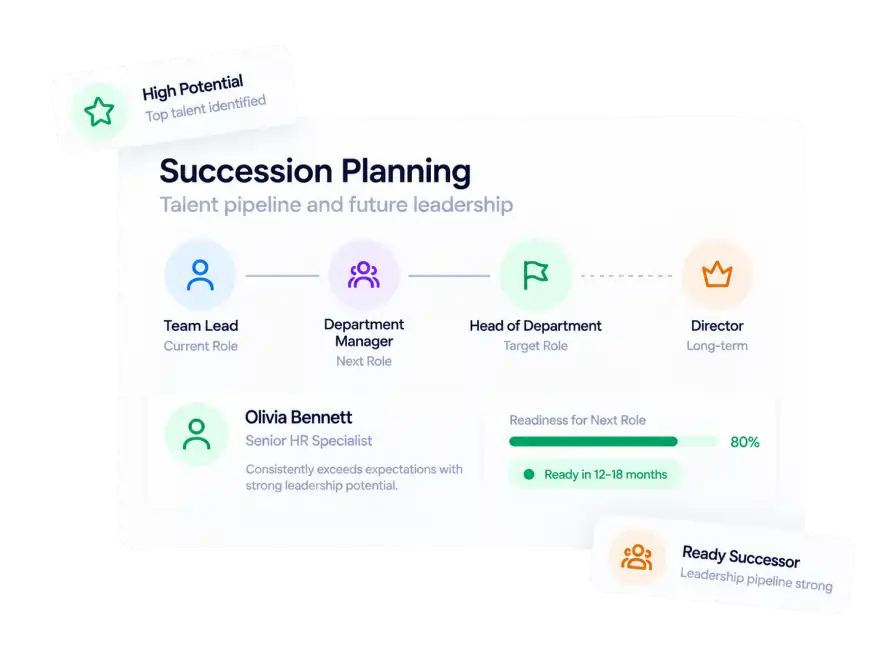
Why do UAE companies need succession and career planning?
The resignation arrives on a Sunday morning. Your finance manager has accepted an offer in Riyadh, and her contract gives you 60 days.
By Tuesday the questions start. Who signs off the WPS file now? Who understands the intercompany recharges? Who does the bank call when something looks wrong?
Nobody has a clean answer, because nobody was ever asked. The two people who could have grown into the role left last year, after their own questions about the next step went nowhere.
That is the quiet cost of running talent on spreadsheets and memory. Under UAE Labour Law, notice periods run from 30 to 90 days, and good people have options across the GCC. A gap you cannot see on Thursday becomes an agency fee, a rushed hire and months of lost knowledge by the end of the quarter.
Workplus HCM puts that gap on screen early, while you still have time to close it.
How does competency-based career development work in Workplus HCM?
Career growth works when everyone reads the same map. Workplus HCM builds that map from competencies, the skills and behaviours each role needs, so a promotion stops being a guess.
Build competency frameworks
“What does a good team lead look like here?”
Create competency libraries for each job or job family, with clear proficiency levels. Every manager works from the same definition of good.
Show clear career paths
“Where can I go from here?”
Employees and managers see the next roles a person can grow into, from coordinator to supervisor to manager, and what each step asks for.
Spot the gaps
“What do I need for the next role?”
Compare a person’s current competencies with the target role. The answer comes back as a short, specific list instead of a vague comment about experience.
Close them with a plan
“Who is doing what, and by when?”
Turn each gap into an individual development plan with actions, owners and dates. Growth gets tracked like any other goal.
Competencies sit next to goals and ratings in Workplus HCM performance management, so one set of data feeds appraisals, promotions and the talent review. For why this matters to retention, our guide to employee engagement in Dubai shows how a visible next step keeps people longer than most perks.
How does succession planning work in Workplus HCM?
Succession planning answers one blunt question. If this person left tomorrow, who would step in? Workplus HCM gives you that answer for every role that matters.
- Flag critical roles. Mark the positions the business cannot run without, such as a finance manager, a site lead or the one engineer who knows the old system inside out.
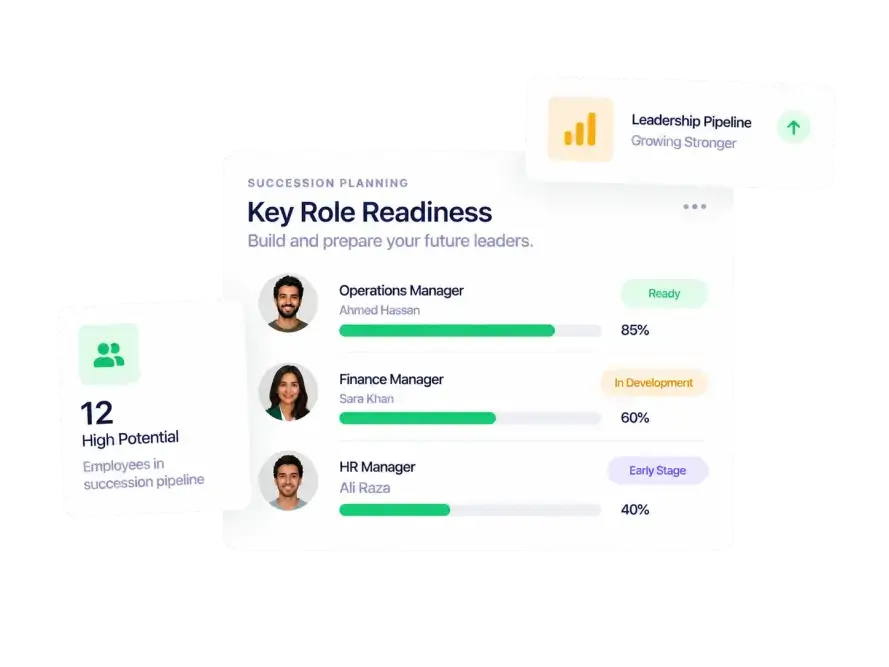
- Name successors by readiness. Nominate successors and rate them as ready now, ready in one to two years or further out. Update readiness as people grow.
- Keep talent pools. Group your high potentials into pools for future roles, so one strong person can be considered for several openings.
- Check bench strength. Bench-strength reports show which critical roles have no ready successor. That is your risk list and your development priority list in one view.
When no internal successor is ready, the gap becomes a planned search in recruitment management instead of a panic. When a successor does step up, the handover can run as a tracked checklist in task management.
What is a 9-box grid, and how does Workplus HCM use it?
A 9-box grid plots each person on two axes: performance today and potential tomorrow. Three levels on each axis give you nine boxes. A pile of ratings becomes a talent map you can read in a minute.
Swipe sideways to see the full grid
Box names vary between companies. What matters is the conversation each box starts.
How Workplus HCM runs it. The 9-box is configurable. Performance can come straight from Workplus HCM appraisal ratings, with managers or HR rating potential, or both axes can be rated during a talent review. Choose the setup that matches how your company already reviews people.
Four rules for a fair talent review:
- Rate potential on evidence, such as stretch work delivered and learning speed, not on personality or visibility.
- Calibrate across managers, so a tough rater and a generous one land on the same scale.
- Run it once or twice a year, straight after the appraisal cycle, while the evidence is fresh.
- Share the plan with the person, not the box. People respond to a next step, not a label.
For a deeper look at the 9-box alongside goals, KPIs and appraisals, read our guide to performance management systems in Dubai.
What makes talent planning different in the UAE?
Short runways for big exits
UAE notice periods run from 30 to 90 days. That is rarely long enough to hire and hand over a senior role from scratch. A ready successor turns a crisis into a transition.
Hiring is only half the target
Private companies with 50 or more employees must raise their share of skilled Emirati employees by 2 percentage points a year, with a 10% target by the end of 2026. Career paths and succession plans are how Emirati talent grows into senior roles instead of leaving them.
Good people have options
Skilled staff in Dubai, Abu Dhabi and across the GCC are approached all the time. A visible next step inside your company is often what keeps them.
One talent map, many entities
Mainland companies, free zone entities and GCC branches often share leaders. Keeping everyone in one system lets a group run one talent review instead of five.
Spreadsheets vs Workplus HCM for talent and succession
| What you need | Spreadsheets and slides | Workplus HCM |
|---|---|---|
| Competency definitions | A different file per manager | One library per job or job family |
| Career paths | In someone’s head | Visible to the employee and the manager |
| Skill gaps | A vague comment in the appraisal | Gap analysis against the target role |
| Successor readiness | Updated once a year, if at all | Rated and kept current |
| 9-box talent review | Drawn in slides before the meeting | Built in, set up your way |
| Bench strength | Unknown until someone resigns | Reported for every critical role |
Which Workplus HCM plan includes talent and career management?
You get talent and career management on the Workplus HCM Platinum plan, alongside performance management, employee surveys and multi-country entity setup. Groups that need custom workflows, job family frameworks and advanced matrix reporting can go further with Workplus HCM 10X.
You can compare every plan on the Workplus HCM pricing page. Not sure where talent fits next to HR and payroll? Our explainer on HRMS vs HRIS vs HCM breaks it down.
See your talent map in a 30-minute demo
Bring one critical role and the people who could step into it. We will show you their competencies, career paths, successor readiness and a 9-box view in Workplus HCM.
Book a free demoFrequently asked questions about talent and career management
What is talent and career management software?
Talent and career management software helps a company grow and keep its people. It holds competency frameworks, career paths, development plans and succession plans in one system, so HR and managers can see who is growing, who is ready for more and which roles are at risk.
What is a 9-box grid?
A 9-box grid is a talent review tool that plots each employee on two axes: current performance and future potential. Each axis has three levels, which creates nine boxes. It helps HR and managers decide who to develop, who to stretch and who is ready for a bigger role.
How do you run a talent review with a 9-box grid?
Managers place each person in a box using appraisal results and real evidence of potential. HR then calibrates the placements across teams so the ratings are fair. The outcome guides development plans, talent pools and succession decisions. Most companies run a talent review once or twice a year, in line with the appraisal cycle.
What is the difference between succession planning and replacement planning?
Replacement planning names a backup for a role in an emergency. Succession planning goes further. It identifies critical roles, rates successors by readiness and develops them over time, so the business has people ready before a role opens.
What is competency-based career development?
It means career growth is built on the skills and behaviours each role needs. Every job has a competency profile, employees can see the profile of the next role, and a gap analysis turns the difference into a development plan with clear actions.
How many successors should a critical role have?
Many companies aim for at least one successor who is ready now and one who could be ready within one to two years. In Workplus HCM, roles with no ready successor show up in the bench-strength report, so you know where to focus development first.
Does the Workplus HCM 9-box use appraisal ratings?
It can. The 9-box is configurable. You can take performance from Workplus HCM appraisal ratings and have managers or HR rate potential, or rate both axes during a talent review.
Which Workplus HCM plan includes talent and career management?
The Workplus HCM Platinum plan includes it, covering competency-based career development, succession planning and the 9-box grid. Workplus HCM 10X adds deeper customisation for larger groups.
Is succession planning only for large companies?
No. A 40-person company can still lose its only payroll specialist or operations lead. Flagging a handful of critical roles and naming one successor for each is often enough to remove the biggest risks.