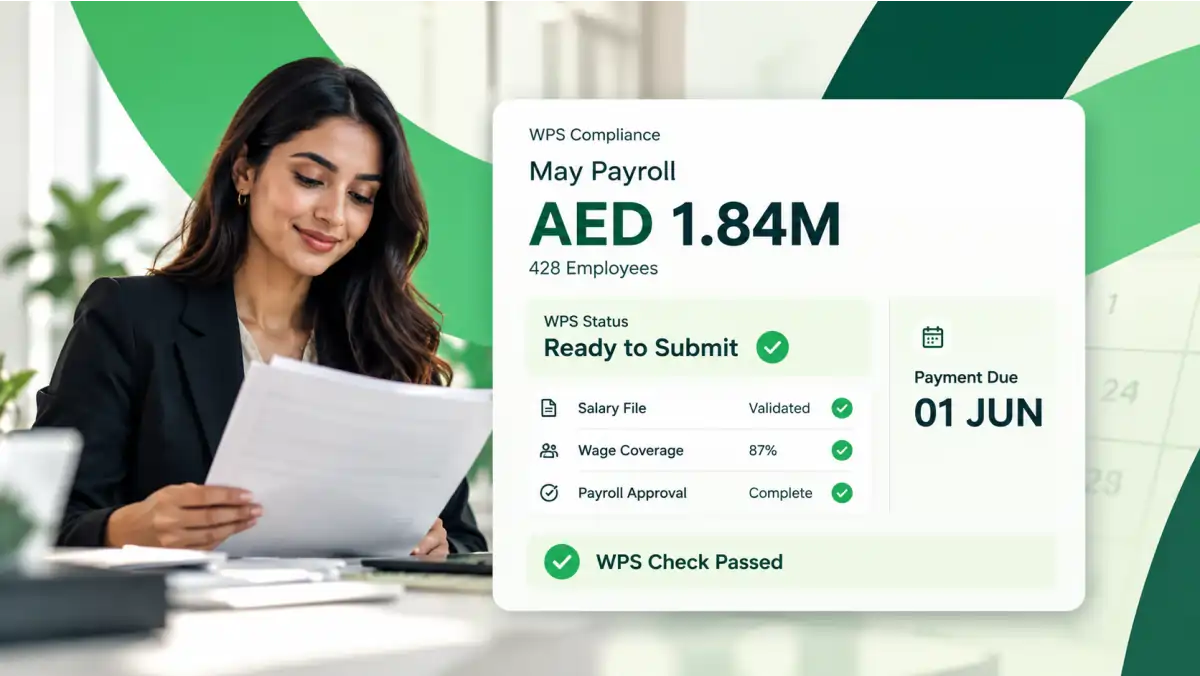
Quick answer: WPS compliance in the UAE in 2026 runs on a tighter clock. Under Ministerial Resolution No. 340 of 2026, in force since 1 June 2026, wages for each month are due on the first day of the following Gregorian month, at least 85% of total wages due must be transferred on time, and the old tolerance window before a salary counted as late should no longer be assumed. Enforcement can start within days of the due date, so payroll now has to be finished, checked and funded before the 1st, not fixed after it.
The email arrives at 8.47am on the sixth of the month. The PRO at a catering company in Al Barsha opens it between two cups of karak. The sender is MOHRE.
The message is short. New work permit applications for the establishment are on hold until a salary issue is resolved.
He has three chefs waiting on permits for a new kitchen that opens in two weeks. He calls finance. Finance is calm. “Salaries went out on the 30th. All of them.”
Not quite. Twenty-two lines bounced. They belonged to a batch of new joiners whose bank details were half complete when the file was built. Nobody chased them, because everyone remembered the old rhythm: there was always a bit of time after the due date to tidy things up.
That bit of time is gone. Since 1 June 2026, WPS compliance in the UAE has been measured from the first day of the month, and a handful of failed lines can hold up hiring for the whole company.
This guide covers what changed in 2026, what the new deadline and 85% threshold mean in practice, why errors happen, and a plan you can put in place this month so the sixth of the month stays an ordinary day.
The Wage Protection System, or WPS, is the electronic channel that tracks how private-sector employers in the UAE pay their people. MOHRE runs it alongside the Central Bank of the UAE and the banks, exchange houses and financial institutions licensed to carry salary transfers.
Moving money is the easy part. The point of WPS UAE monitoring is to show whether each worker received the wage in their contract, and whether it arrived on time. Every salary run you send creates a record MOHRE can read.
If your establishment is registered with MOHRE, your WPS employer obligations look like this:
None of these is new. What changed in 2026 is how little time you have to get them right.
Ministerial Resolution No. 340 of 2026 came into force on 1 June 2026. It replaced the earlier framework under Ministerial Resolution No. 598 of 2022. If you want the resolution read line by line, our plain-English guide to WPS UAE 2026 and Ministerial Resolution 340 does exactly that. Here we focus on what each change means for your next payroll.
Wages for a month are now due on the first day of the next Gregorian month. That is the WPS salary deadline 2026 employers should plan around.
| Salary month | Due date |
|---|---|
| June | 1 July |
| July | 1 August |
| August | 1 September |
| September | 1 October |
The date is fixed to the calendar, not to your habits. Do not assume a weekend or public holiday at month end buys you extra days. Plan your bank cut-offs backwards from the 1st.
The official UAE government guidance says employers must transfer at least 85% of the total wages due on time to meet the requirement. Under the previous framework the figure was lower.
Read that as a floor, not a target. A worked illustration: a company with a monthly wage bill of AED 1,200,000 needs at least AED 1,020,000 to reach employees on time. A single failed batch of AED 200,000, perhaps one site’s crew with a bank problem, takes the on-time figure to AED 1,000,000. That is below the line.
The safer aim is 100% of salaries, correct and on time, every month. The threshold is there to measure you, not to give you slack.
Under the old framework, an employer had some room after the contractual due date before a salary was classed as late. Many payroll calendars were built around that room, whether anyone said so or not.
The 2026 framework fixes the 1st as the payment date and brings enforcement forward. In practice, a wrong IBAN, an incomplete employee record or a bank rejection discovered on the 2nd leaves you very little time to investigate and resubmit. Payroll has to work backwards from the deadline, with the fixing done before it.
Do not assume a new hire gets the kind of grace period that existed under the earlier rules. Treat every joiner as part of the next WPS cycle from the start.
For each new employee, confirm before the run:
Companies that hire in waves feel this most. Hospitality before the season, construction at the start of a project, retail before Ramadan. Those are the months when half-finished joiner records slip into a SIF.
The biggest operational shift is speed. Current government guidance describes gradual measures that start shortly after the salary due date, not after a long correction window.
The government is clear that private-sector employers should pay through WPS to avoid penalties and fines. The 2026 framework takes a progressive approach, and the exact action depends on the circumstances, the establishment’s status, the nature of the violation and the provisions that apply.
Possible consequences include:
Searches for a specific WPS fine in UAE terms often turn up figures copied from older articles. Fine amounts and the precise day each measure applies are set by MOHRE and can change, so confirm today’s numbers directly with MOHRE before you quote them to your board. That applies to this article too.
For most companies the painful penalty is not a fine. It is the freeze. A hold on new work permits stops hiring, delays project starts and leaves new recruits waiting at home. The catering kitchen in our opening could not open on time because of twenty-two bank lines.
The Salary Information File is the document your bank or exchange house uses to process salaries through WPS. Depending on your banking arrangement, it can carry:
Every one of those fields is a place where the file can fail.
Most WPS problems are operational, not deliberate. These are the usual causes:
Rejections have a pattern, and our field-by-field look at WPS errors and penalties UAE payroll teams run into explains what each one costs.
Avoiding WPS penalties comes down to a payroll process that finishes early and checks itself. Seven habits do most of the work.
Never make the 1st your processing day. Set internal deadlines that land days before it. A sample timetable:
| Activity | Recommended timing |
|---|---|
| Employee data freeze | 7 to 10 days before the payment date |
| Payroll calculation | 5 to 7 days before |
| Management approval | 4 to 5 days before |
| SIF validation | 3 to 4 days before |
| Bank submission | 2 to 3 days before |
| Transaction check | 1 day before |
| Receipt confirmed | Payment date |
The middle rows depend on your WPS salary processing time. Ask your bank or exchange house how long a file takes from upload to credit, and what its cut-off hour is. Then add a buffer for one failed resubmission. If your agent needs a working day and your month ends on a Friday, your real deadline may be the Wednesday before.
IBAN errors are among the easiest to prevent. Before each cycle, look for:
Accept bank changes only through a formal request with supporting proof, never a forwarded message.
The SIF is the last step, not the place where problems are found. Check these before you build it:
WPS compliance is only as good as the data under it. When records live in several spreadsheets, one can hold a new IBAN while the payroll file still uses the old one. A single central employee database removes that duplication.
A successful upload does not mean every employee was paid. Check the transaction results line by line. If a payment fails:
Keep an audit trail that would satisfy an inspector. Depending on your business, that means payroll registers, salary files, bank confirmations, payment reports, employee salary records, approvals, reconciliations, failed transaction reports, records of corrective action and support for every lawful deduction.
Spreadsheets are fine for analysis. As the engine of a monthly payroll they invite copy-and-paste slips, broken formulas, duplicate employees, stale bank details, missed joiners, wrong deductions, version confusion and approvals that arrive late. Under a 1st-of-month deadline, each of those can cost you days you no longer have.
Reading about the rules is easy. Changing the way your team works before the next 1st is the hard part. Here is a four-week plan that fits around a normal month.
Make WPS compliance a monthly process, with owners and dates, and the rules stop being a surprise.
The sequence your team repeats each cycle is short enough to fit on a whiteboard: review, calculate, validate, approve, generate the SIF, submit, monitor, reconcile, document.
Payroll software will not make you compliant on its own. What it can do is remove the manual hand-offs where most WPS failures start. When you look at WPS compliance software UAE vendors offer, judge it on the workflow, not the brochure.
Capabilities worth checking:
The shorter window changes the maths. When you had extra days after the due date, a manual process could survive a mistake. Now it often cannot.
Compare the two routes a salary takes.
Manual route: employee data, then a spreadsheet, then the payroll calculation, then a hand-built SIF, then a bank rejection, then an investigation, then a correction. Problems surface at the bank.
Integrated route: employee data, then validation, then the payroll calculation, then an exception check, then automatic SIF generation, then submission, then payment monitoring. Problems surface before the file leaves.
The second route gives finance visibility days earlier. How cloud tools reshape the rest of the pay cycle, from gratuity accrual to access control, is the subject of our main guide to cloud payroll software Dubai companies use.
Run this before every monthly cycle. Tick each line or give it an owner.
Employee data
Pay
File and payment
Compliance
Mistake 1: Processing payroll on the deadline. It leaves no room for a bank delay or a correction.
Mistake 2: Assuming one failed salary does not matter. Even a single failure deserves a same-day look. Several of them can move your on-time percentage fast.
Mistake 3: Using outdated employee information. Old IBANs and stale salary details are the classic cause of rejected payments.
Mistake 4: Treating WPS as only a finance responsibility. HR, finance, management and employees all feed the data that payroll depends on.
Mistake 5: Ignoring new hires. Bring joiners into the payroll and WPS process from the start, without counting on an old grace period.
Mistake 6: Waiting for a warning. Watch your own status. By the time a MOHRE notice arrives, as in Al Barsha, the hold may already be in place.
Mistake 7: Relying on outdated WPS articles. Plenty of online guidance still describes the pre-2026 rules. Check that anything you follow reflects Ministerial Resolution No. 340 of 2026 and current government guidance.
Workplus HCM is our own HR and payroll system, written in Dubai with the 1st-of-month reality of UAE and GCC payroll in mind. Tuscan Consulting, the HR advisory firm behind it, has worked with more than 450 clients across the Gulf.
For WPS, the useful part is that the steps above happen in one place. Each payroll run produces its SIF automatically, from the same approved figures that appear on payslips. Clock-ins reach payroll from the employee app (geofenced, with a selfie check) or from whichever biometric readers you already have on site, and leave sits in the same system, so overtime and unpaid days reach payroll without retyping. Visa and labour card expiry alerts flag gaps before they turn into a failed line, and gratuity is calculated under UAE Labour Law.
To see a full monthly cycle, from cut-off to file, visit our page on payroll software in Dubai. The payroll and WPS features start on the Power plan. That plan costs AED 16 a head each month, and there is no minimum team size. Every tier is compared side by side on the pricing page.
The PRO in Al Barsha got the hold lifted once the twenty-two salaries were paid and the records fixed. The chefs started a week late. The lesson cost the company a delayed opening, not a fine, and it was entirely avoidable.
WPS compliance in the UAE in 2026 rewards teams that finish early. Freeze your data a week ahead, validate the SIF before it leaves, confirm every line by the 1st, and keep the paperwork. Treat the 85% figure as a floor you never go near.
WPS rules and enforcement steps can change, so confirm current requirements with MOHRE and take professional advice for anything specific to your business. If you want to watch a payroll month run from data freeze to confirmed payment in one system, book a free Workplus HCM demo.
Last reviewed: 26 October 2026. This guide reflects the WPS rules as we read them on that date. Workplus HCM and Tuscan Consulting are HR specialists, not a law firm, so confirm specifics with MOHRE or a qualified legal adviser before you act.
Wages for each month are due on the first day of the following Gregorian month, so July salaries are due on 1 August. This applies to establishments covered by MOHRE’s WPS framework under Ministerial Resolution No. 340 of 2026. Build your internal timetable so payments are confirmed by that date, not started on it.
At least 85% of total wages due must be transferred on time under the 2026 framework, subject to the applicable rules. On a monthly wage bill of AED 500,000, that means at least AED 425,000 paid by the due date. Aim for every salary, because one failed batch can move you close to the line.
The 2026 framework set the 1st of the month as the salary due date and brought enforcement forward, so employers should no longer count on the old tolerance period. Plan to have every salary paid and confirmed by the 1st. Any fix you need should happen before that date, not after it.
A Salary Information File, or SIF, holds the employer, employee and payment details your bank or exchange house needs to process salaries through WPS. It typically includes IDs, bank accounts, amounts, pay components and payment dates. If any field is wrong, the whole file or individual lines can be rejected.
Yes. A mistyped, outdated or closed account will cause that employee’s payment to fail, and under a 1st-of-month deadline there is little time to fix it. Validate every new or changed IBAN before the file is built, and accept bank changes only through a formal request.
Combine accurate employee records, an early payroll calendar, SIF validation, documented approvals, same-day monitoring of failed payments and good record keeping. Software that builds the SIF from approved payroll data removes many manual errors. A named owner for each step matters as much as any tool.
No. The rules that apply depend on the establishment, how it is registered and which authority regulates it. Government guidance also lists some categories of employers and employees that are excluded from WPS. If you operate in a free zone or another specialised jurisdiction, confirm which salary-payment framework covers you.