November 4, 2026
Running a business in the UAE comes with several responsibilities beyond attracting customers and generating revenue. Whether you operate a small trading company in Dubai, a growing consultancy in Abu Dhabi, a retail business in Sharjah or a service-based organisation in Ajman, managing employees efficiently is an important part of business success.
As companies grow, handling employee information, attendance records, leave applications, salary calculations, documentation and internal communication through spreadsheets and manual processes becomes increasingly difficult.
This is where modern Human Capital Management (HCM) platforms can make a significant difference.
However, one question frequently comes up when SME owners start exploring digital HR solutions:
How much should a small or medium-sized business actually budget for HR software in 2026?
The answer depends on several factors, including employee headcount, required features, payroll complexity, number of business locations, implementation requirements and the level of automation needed.
Some providers charge a fixed monthly subscription, while others follow a per-employee pricing model. Certain platforms offer basic employee administration at relatively affordable rates, whereas more comprehensive systems include payroll automation, workforce planning, reporting, performance reviews and advanced integrations.
For UAE SMEs, the objective should not simply be to purchase the cheapest available subscription. It should be to find a solution that reduces administrative expenses, improves operational accuracy and supports future business expansion.
In this guide, Workplus HCM explains realistic budgeting expectations, pricing structures, additional expenses and important considerations that UAE businesses should understand before investing in an HR technology platform.
Before deciding how much to spend, business owners should understand how software providers calculate their subscription fees.
There are several common pricing models in the market.
This is one of the most common subscription structures.
Under this arrangement, businesses pay a fixed amount for every employee registered on the platform.
For example, if a provider charges AED 12 per employee per month, a company with 25 employees would pay:
25 × AED 12 = AED 300 per month.
Similarly, an organisation with 50 employees would pay AED 600 per month.
The biggest advantage of this model is transparency. Businesses can estimate their monthly expenses easily and increase their subscription as their workforce grows.
It is particularly suitable for startups, SMEs and companies with changing employee headcounts.
Some providers charge a fixed monthly amount for a specified number of employees.
For example, a subscription might cost AED 299 per month and include up to 25 employees.
Additional charges may apply when the workforce exceeds the included limit.
This approach can be attractive for businesses with a relatively stable workforce because monthly expenses are predictable.
However, companies should examine the additional employee charges carefully. A subscription that initially appears inexpensive may become considerably more expensive as the organisation expands.
Some platforms divide their offerings into multiple subscription tiers.
A basic package may cover employee information, leave records and attendance tracking.
A higher package may include payroll, onboarding, expense claims, shift scheduling and additional operational tools.
Premium packages may offer workforce analytics, performance reviews, AI-powered assistance, multi-entity administration and advanced reporting.
This pricing model allows businesses to select a package according to their requirements rather than paying for every available capability.
The important consideration is to understand which features are genuinely included and which require additional payments.
Larger organisations may require customised solutions.
For example, a company operating across Dubai, Abu Dhabi and other emirates may have different administrative teams, approval structures, reporting requirements and payroll workflows.
In such cases, providers may offer customised quotations based on:
Although customised solutions may involve higher initial investment, they can provide better operational flexibility for complex organisations.
In 2026, publicly advertised subscription prices in the UAE market vary significantly depending on the features and commercial model offered.
A useful starting point is to distinguish between basic employee administration, integrated payroll and more advanced workforce management.
The following figures provide an indicative budgeting framework rather than a universal market tariff.
| Business requirement | Indicative monthly budget |
|---|---|
| Basic employee administration | AED 100–300 |
| Employee administration with attendance | AED 200–600 |
| Integrated HR and payroll | AED 300–1,000 |
| Advanced workforce management | AED 600–1,500 |
| Complex multi-entity requirements | Custom quotation |
Actual prices depend on employee numbers, subscription tiers and additional services.
For comparison, publicly available UAE pricing pages show entry-level subscriptions around AED 6–14 per employee monthly from some providers, while other platforms publish fixed monthly packages or different per-user rates.
For example, Zoho Payroll advertises annual-billing plans starting at AED 35 per organisation monthly for five employees, with additional employee charges. Real Workforce publishes packages starting at AED 299 monthly for 25 employees. These examples illustrate why comparing only the headline subscription price can be misleading.
For SMEs, a sensible approach is to calculate the total monthly cost at the current headcount and forecast the expense at the expected headcount over the next 12 months.
Workplus HCM offers published per-employee pricing designed to help businesses understand their technology expenses before committing to a subscription.
The pricing structure consists of three main packages.
The Standard package is suitable for organisations looking to move away from manual HR administration and establish a centralised employee management system.
Its features include:
This package can be particularly useful for smaller businesses that need better control over everyday employee administration without immediately investing in advanced payroll automation.
The Power package includes the Standard features and adds additional operational capabilities.
These include:
For businesses that need employee administration and payroll processes within one platform, this package offers a more comprehensive option.
The Platinum package is designed for organisations that require more advanced workforce planning and management capabilities.
In addition to the Power features, it includes:
This package can be relevant for businesses with multiple departments, more complex organisational structures or plans to expand internationally.
| Plan | Monthly price per employee | Best suited for |
|---|---|---|
| Standard | AED 12 | Essential HR administration |
| Power | AED 16 | HR administration and payroll |
| Platinum | AED 22 | Advanced workforce management |
Workplus HCM does not impose a minimum employee headcount on its published plans.
A one-time implementation fee of AED 850 may apply, covering implementation and training. Monthly, quarterly and annual billing options are available. Businesses should confirm the applicable quotation and tax treatment before purchasing.
This structure gives SMEs an opportunity to start with the features they currently need rather than paying for an unnecessarily complex system.
Understanding per-employee pricing becomes much easier when translated into actual business expenses.
Let’s consider three common SME scenarios.
Imagine a consultancy or small trading company in Dubai with ten employees.
Its primary requirements include employee records, attendance, leave administration and document management.
Using the Standard package:
10 employees × AED 12 = AED 120 per month.
Estimated annual subscription:
AED 120 × 12 = AED 1,440.
This is a relatively modest investment for a business that wants to establish organised employee administration.
If the business also requires payroll automation, the Power package would cost:
10 × AED 16 = AED 160 per month.
Annual subscription: AED 1,920.
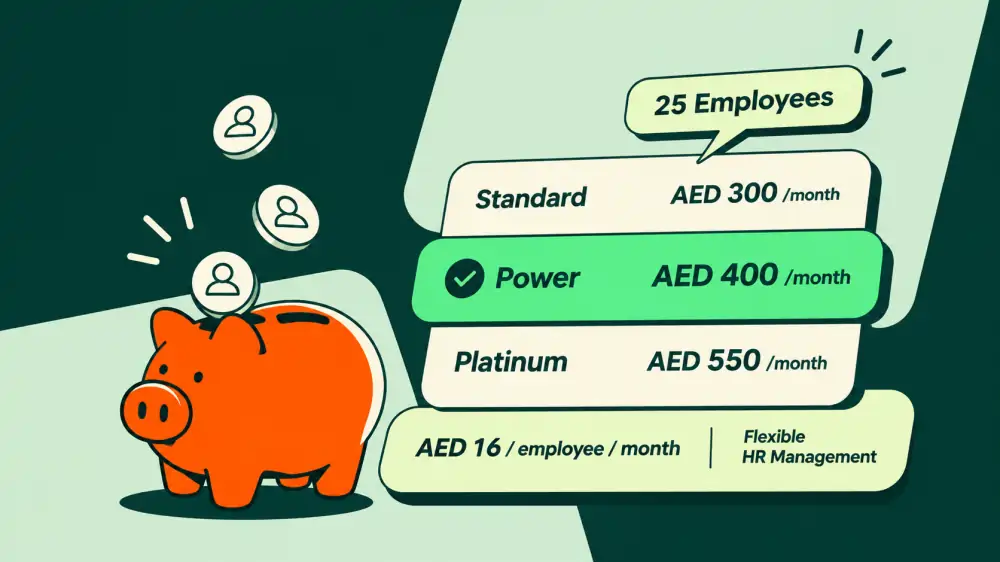
Consider a retail company, marketing agency or professional services organisation employing 25 people.
At this stage, manually maintaining employee information, attendance records and salary calculations may consume considerable administrative time.
The estimated subscription expenses would be:
| Package | Monthly expense | Annual expense |
|---|---|---|
| Standard | AED 300 | AED 3,600 |
| Power | AED 400 | AED 4,800 |
| Platinum | AED 550 | AED 6,600 |
For a business requiring automated salary processing and additional employee lifecycle workflows, the Power package may be worth evaluating.
A company with 50 employees may have multiple departments, supervisors, shift schedules and approval processes.
At this stage, maintaining separate spreadsheets for different administrative functions can create unnecessary duplication.
Its estimated subscription expenses would be:
| Package | Monthly expense | Annual expense |
|---|---|---|
| Standard | AED 600 | AED 7,200 |
| Power | AED 800 | AED 9,600 |
| Platinum | AED 1,100 | AED 13,200 |
These calculations use the published subscription rates and exclude any applicable VAT or additional services.
The key takeaway is that businesses can estimate their costs accurately before selecting a subscription.
The monthly subscription is not necessarily the only expense associated with implementing a new technology platform.
Many business owners focus exclusively on the advertised price and overlook other potential costs.
Here are some expenses worth discussing with a provider before signing an agreement.
Implementation may involve creating company profiles, configuring employee records, setting up approval hierarchies and defining internal policies.
Some providers include standard implementation within their subscription.
Others charge a one-time fee.
Businesses should clarify whether the quoted amount includes:
Companies switching from spreadsheets or older systems may have years of employee information to transfer.
This can include personal details, employment records, salary history, leave balances and supporting documents.
Ask whether standard imports are included in the subscription or whether advanced data cleansing and migration attract additional charges.
Some businesses prefer physical biometric devices for employee check-ins.
If existing devices are compatible, connecting them may be more economical than purchasing new equipment.
However, organisations introducing biometric attendance for the first time should budget separately for hardware, installation and integration where required.
A business may want its employee platform to connect with accounting applications, identity management tools or existing business systems.
Not every integration is included in every package.
Check whether the provider charges for API access, custom integrations or additional configuration.
Employees and managers need to understand how to use the system correctly.
A good implementation programme should explain how to submit requests, approve transactions, manage employee information and generate reports.
Clarify whether training is included, how many sessions are provided and whether additional support attracts fees.
UAE businesses should also account for applicable taxes when calculating the final subscription expense.
The standard UAE VAT rate is 5%.
For example, a monthly subscription of AED 400 would become AED 420 after adding 5% VAT, assuming the service is taxable and the quoted price excludes VAT.
Eligible VAT-registered businesses should consult their tax adviser regarding input VAT recovery.
One of the most important considerations when selecting an employee management platform in the UAE is payroll accuracy and regulatory compliance.
Businesses must ensure that employee salaries are processed correctly and paid within applicable deadlines.
For establishments subject to the Wage Protection System (WPS), salary payments must follow the relevant requirements.
The UAE government has published guidance explaining employer responsibilities concerning timely salary payments and WPS compliance.
Consequently, businesses should not evaluate payroll tools based only on their subscription price.
They should examine whether the system supports:
A system that reduces payroll errors and unnecessary manual calculations can provide substantial operational value.
SMEs should also verify that the provider’s payroll functionality supports their specific legal entity, banking arrangements and employee categories.
Remember that software can support compliance, but the employer remains responsible for meeting applicable legal requirements.
Not every business requires the same set of capabilities.
A small consultancy has different administrative requirements from a construction company managing employees across several project sites.
The following framework can help decision-makers shortlist suitable options.
Smaller organisations should prioritise simplicity and affordability.
Important requirements include employee records, document storage, leave administration and attendance visibility.
A basic subscription may be sufficient initially.
However, if salaries are processed regularly and payroll administration is becoming difficult, investing in integrated payroll functionality may be worthwhile.
At this stage, the administrative workload usually increases.
Managers may need approval workflows, timesheets, attendance reports and better visibility into employee information.
Companies should consider whether bringing payroll and employee administration into one system will reduce repetitive work.
Growing organisations often need better departmental coordination.
They may have different supervisors, multiple shift schedules, approval structures and employee responsibilities.
Automation becomes increasingly valuable because the cost of manual administration grows alongside headcount.
Businesses should evaluate reporting, payroll integration, mobile access and operational flexibility.
Companies in this category may benefit from advanced reporting, workforce planning and more structured employee processes.
They should also examine access permissions, data security, integration capabilities and the ability to manage multiple locations.
Larger organisations should assess their requirements in greater detail.
Factors such as multiple legal entities, international operations, custom workflows, integrations and management reporting may influence the final quotation.
The objective should be to select a scalable platform that can support future operational requirements without requiring frequent system changes.
Software subscriptions should be evaluated as business investments rather than simply additional monthly expenses.
Consider a company with 25 employees where an administrator spends approximately 20 hours every month handling repetitive employee-related activities.
These activities could include:
If automation reduces this workload by eight hours monthly, the organisation saves approximately 96 administrative hours annually.
Now consider an illustrative administrative labour cost of AED 35 per hour.
Annual time savings:
96 × AED 35 = AED 3,360.
If the company uses the Power package for 25 employees, its annual subscription is AED 4,800.
In this simplified example, the measurable time savings alone do not cover the entire subscription.
However, the calculation excludes other potential benefits such as fewer payroll errors, improved record accessibility, faster approvals, better reporting and reduced administrative delays.
It is also important to recognise that time saved can be redirected towards more productive work.
For example, an HR administrator could spend more time improving employee communication, supporting recruitment and helping managers address workforce challenges.
The real return on investment should therefore consider both direct savings and improvements in operational productivity.
Technology requirements are changing as businesses become more digitally connected.
When evaluating a platform, consider the following capabilities.
Employee details should be available through a centralised and secure system.
Businesses should be able to maintain employee profiles, employment information and relevant documents without searching through multiple spreadsheets.
For companies with field employees, sales representatives, project teams or multiple locations, attendance visibility can be particularly valuable.
Features such as geofencing, mobile check-ins, selfie verification and biometric integrations can support better workforce monitoring.
Manual leave tracking can result in incorrect balances and confusion between employees and supervisors.
A digital approval process helps maintain accurate records and improves visibility into employee availability.
Salary processing should be accurate, consistent and easy to review.
Businesses should look for support for relevant salary structures, deductions, overtime, payslips and WPS-related workflows.
A structured onboarding process helps new employees complete documentation, understand company procedures and settle into their responsibilities.
Automated checklists and reminders can reduce administrative follow-ups.
Management decisions become easier when reliable workforce information is readily available.
Reports covering attendance, leave trends, employee numbers and operational activity can help businesses identify patterns and improve planning.
Many employees and managers prefer accessing company services through their smartphones.
A mobile application can simplify routine activities such as attendance check-ins, leave requests, approvals and internal communication.
Artificial intelligence is gradually becoming part of modern workplace technology.
AI-based assistants can help employees find information, answer routine questions and reduce repetitive administrative communication.
However, businesses should assess practical usefulness, information security and accuracy before relying on AI-generated responses.
Even companies that recognise the importance of automation can make costly purchasing decisions.
Here are some mistakes worth avoiding.
Choosing a system only because it is cheap: A low subscription fee does not guarantee that essential functionality is included.
Paying for unnecessary features: A small organisation may not need sophisticated workforce analytics or complex international reporting.
Ignoring implementation expenses: Data migration, configuration and training can influence the actual first-year investment.
Overlooking payroll requirements: Businesses should verify WPS compatibility and relevant salary calculation capabilities.
Not considering future expansion: A platform that works for ten employees should ideally support the organisation as it grows.
Ignoring employee experience: A complicated interface may discourage adoption and reduce the benefits of automation.
Failing to check customer support: Timely assistance is particularly important during payroll cycles and initial implementation.
Not reading subscription terms: Understand renewal conditions, cancellation policies, data export options and additional charges.
A careful evaluation before purchasing can prevent unnecessary expenses and reduce the risk of changing platforms later.
Before approving an annual technology budget, business owners should answer the following questions:
Once these questions are answered, it becomes easier to determine the appropriate package and estimate the total investment.
For most SMEs, it is sensible to prepare two budgets:
First-year budget: Subscription, applicable setup, migration, training, hardware and taxes.
Ongoing annual budget: Subscription renewals, applicable taxes, additional licences and any recurring support or integration expenses.
This approach provides a more realistic financial picture than comparing monthly subscription prices alone.
Workplus HCM provides a structured approach to employee administration, workforce management and payroll-related operations.
Its published pricing is designed to make subscription costs easier to calculate.
Businesses can choose from three packages depending on their operational requirements:
The platform combines several workplace processes, helping businesses reduce dependence on disconnected tools and manual administration.
Its capabilities include employee information management, attendance monitoring, leave administration, payroll automation, employee onboarding, workforce planning, performance reviews and reporting.
Another important consideration for smaller organisations is the absence of a minimum employee headcount requirement on the published plans.
This allows businesses to evaluate the platform according to their actual workforce size.
Whether a company has ten employees or a growing workforce across multiple departments, selecting the appropriate package can help establish more organised employee management processes.
For organisations planning to expand, having access to additional capabilities within the same platform can also reduce the need to introduce separate systems as requirements become more complex.
The best way to determine whether the platform meets your needs is to review its features, discuss your operational requirements and evaluate the pricing against your current administrative processes.
Costs vary depending on employee headcount and required functionality. Basic packages may start at approximately AED 100–300 monthly for smaller teams, while more comprehensive packages can cost several hundred dirhams or more.
For an accurate estimate, businesses should calculate the cost per employee and check for additional implementation expenses.
A company with 25 employees can use an indicative monthly budget of AED 300–600 for many basic or integrated employee administration requirements, depending on its chosen package.
For example, the published Workplus HCM rates would result in AED 300 for Standard, AED 400 for Power and AED 550 for Platinum.
No. Some providers offer payroll as part of their standard subscription, while others include it only in higher packages.
Workplus HCM includes payroll functionality in its Power and Platinum packages.
Yes. Businesses subject to WPS requirements should ensure that their payroll system supports the relevant salary payment processes and file generation requirements.
They should also verify that the system supports their banking arrangements.
Implementation charges vary between providers.
Some include standard configuration and training within their subscriptions, while others charge a separate one-time fee.
Workplus HCM states that an AED 850 implementation fee may apply.
Yes. Smaller organisations can benefit from centralised employee records, leave tracking, document storage and attendance management.
There is no need to wait until a business employs 50 or 100 people before introducing organised administrative processes.
Monthly billing provides flexibility and can be useful when evaluating a new platform.
Annual billing may offer savings, depending on the provider’s commercial terms.
Businesses should compare the total annual cost, renewal conditions and cancellation policies before deciding.
The standard VAT rate in the UAE is 5%. Businesses should confirm whether advertised subscription prices include or exclude applicable VAT.
Yes. Automation can reduce repetitive work associated with attendance records, employee information, approvals, document management and salary processing.
The actual savings depend on workforce size, existing processes and employee adoption.
The Standard package is suitable for essential employee administration.
Power is appropriate for businesses that also require payroll automation and employee lifecycle workflows.
Platinum is designed for organisations requiring more advanced workforce planning, performance management and multi-country administration.
The right choice depends on the company’s present requirements and expansion plans.
For UAE SMEs, investing in employee management technology should be a practical business decision rather than an unnecessary administrative expense.
The right platform can help reduce manual work, improve employee record management, simplify approvals, streamline payroll processes and provide management with better workforce visibility.
However, businesses should evaluate the complete financial picture before purchasing.
Consider the subscription fee, implementation, data migration, additional integrations, hardware requirements, support and applicable taxes.
A company with ten employees may not need the same package as an organisation with 100 employees. Similarly, a business operating from one office may have very different requirements from a company managing several branches.
The objective should always be to select a solution that provides genuine operational value at a sustainable cost.
With transparent per-employee pricing and three packages starting at AED 12 per employee per month, Workplus HCM offers UAE businesses an opportunity to introduce structured employee management while keeping technology expenses predictable.
Instead of spending valuable working hours managing spreadsheets and repetitive administrative tasks, business owners and HR teams can focus on building productive teams and growing their organisations.
Ready to simplify your HR operations?
Explore Workplus HCM, compare the available packages and discover how the right technology can support your business in 2026.
Visit: https://workplus.ai/
Book a free demo: https://workplus.ai/pricing/
Pricing information and feature inclusions are based on publicly published information available in November 2026. Subscription rates, taxes, promotional offers and commercial terms should be reconfirmed with the provider before purchase.
Explore Workplus HCM plans, pricing and features, or book a demo at workplus.ai/pricing/.