September 14, 2026
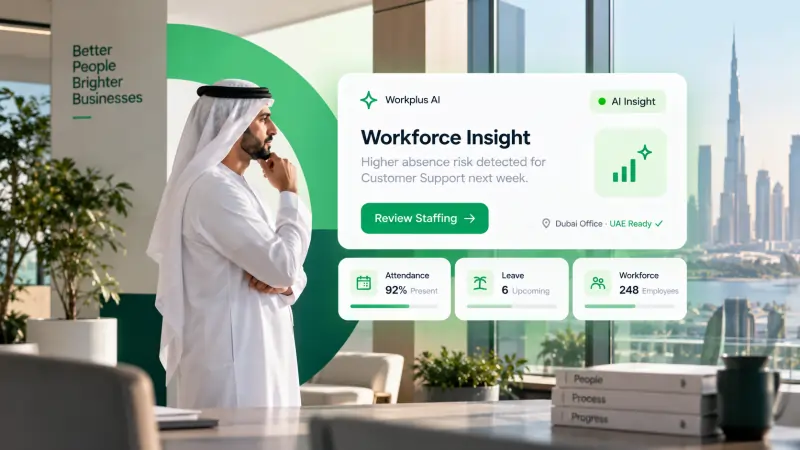
Quick answer: The AI-driven employee management strategies UAE managers can use today fall into five areas: forecasting headcount, drafting rotas that respect labour law, reading performance signals, spotting retention risk early and watching for fatigue. The software forecasts, drafts and flags. The manager still decides, explains and holds the conversation. These strategies work best on one HCM platform where attendance, leave, payroll and performance share the same employee record.
Saturday, 10.15pm, a flat in Discovery Gardens. Joel has his laptop open on the dining table, a cold cup of karak beside it, and a rota template that someone built in 2023 and nobody has dared to touch since.
He runs 45 people at a warehouse in Jebel Ali across three shifts: 6am to 2pm, 2pm to 10pm and 10pm to 6am. Every Saturday night he builds next week’s rota by hand. Four people are on annual leave. One picker has his visa medical on Tuesday morning. A forklift driver hurt his back last month and should not be on nights yet. A vessel docks on Monday, which means Tuesday and Wednesday will be brutal.
He moves names between columns for three hours. He checks who did last Friday’s rest-day cover so the same two people do not get it again. At 1.20am he exports the sheet as an image and posts it to a WhatsApp group called “WH3 Shifts”.
At 6.05am on Sunday, two pickers turn up for the wrong shift. They were reading last week’s picture.
Nobody in this story is careless. Joel is good at his job. The problem is that the best manager on the site spends his weekend doing arithmetic a system could draft in seconds, and still has no time left for the part only he can do: noticing that one of his best people has gone quiet.
This guide is for managers like Joel. It sets out five practical strategies (workforce planning, scheduling, performance signals, retention risk and wellbeing), what AI can do inside each one, and what stays firmly on the manager’s desk. It then covers how to choose and roll out a platform without buying a buzzword.
Traditional HR software is a filing system with a calculator attached. It stores who works for you, what you pay them and how much leave they have. It runs the rules you give it.
AI-powered HR software adds a layer that reads those records for patterns. Instead of only showing that a picker took four single sick days this quarter, it can point out that three of them followed a night shift. Instead of making an employee email HR to ask about a leave balance, an assistant can answer from the policy and the employee’s own record. Instead of a manager exporting three spreadsheets to see overtime by team, a dashboard shows the trend and highlights the outlier.
For a line manager, the shift is simple to describe. Old software told you what happened. AI-powered tools start to tell you what is likely to happen next, and which part of it deserves your attention.
The technology has moved through recognisable stages:
Most UAE employers are somewhere between stages three and four. Stage five is only as good as the data built up in stage four, which is why this guide keeps coming back to clean, connected records.
A team of 45 in Jebel Ali can easily include a dozen nationalities, four or five first languages and staff on very different contracts. Some work in a cold store, some drive, some sit in an office above the loading bay. The same company may run a showroom in Al Quoz and a site office in Abu Dhabi.
That mix puts more HR work on line managers than most job descriptions admit. They approve leave, plan cover, track overtime, handle swaps, answer payslip questions and chase documents. HR teams in the UAE are often thin, so the manager is the first and sometimes the only HR contact a frontline worker has.
The rules are also precise. UAE Labour Law fixes the normal working day at 8 hours and the week at 48. Overtime is normally limited to 2 hours in any one day. Ramadan trims two hours from each working day. Salaries move through the Wage Protection System, and since June 2026 each month’s pay is due on the 1st of the next month. A rota is never just a rota here. It is a compliance document.
Before the strategies, settle the division of labour. It keeps every later decision honest.
| The software can | The manager still owns |
|---|---|
| Forecast next month’s workload from history | Deciding whether to hire, use overtime or bring in temporary staff |
| Draft a rota that respects hours, rest days and leave | Fairness: who gets nights, who gets Fridays off, who needs flexibility |
| Show a drop in someone’s output or attendance | Finding out why, and what support makes sense |
| Rank people by retention risk | The stay conversation, and what you can offer |
| Flag heavy overtime or skipped leave | Telling someone to go home, and rebalancing the work |
| Answer routine policy questions | Anything sensitive, disputed or personal |
Every AI-driven employee management strategy below follows that split. If you are weighing a platform for this kind of work, see how HCM enterprise solutions in Dubai tie attendance, payroll and performance to a single employee file. For the wider view of what AI does inside an HR system, including governance and the national AI agenda, the AI HRMS in the UAE guide is the place to begin.
Count the messages a shift manager handles in a normal week. Can I swap Thursday with Arun? How many leave days do I have? Why is my overtime missing? Where do I send my new passport copy? Can I leave early for my Emirates ID appointment?
None of these is hard. Together they eat hours, and they arrive at 11pm on WhatsApp because that is where the manager is reachable.
AI and workflow automation take a share of that load in three ways:
The result for the manager is not zero messages. It is fewer messages that need a human, and a clear record of the ones that do.
Self-service has existed for years: download a payslip, submit a leave request. AI makes it conversational. A picker can type “how much annual leave do I have left?” in plain English or Arabic and get an answer, rather than hunting through menus he opens twice a year.
That matters on a warehouse floor, where staff live on their phones. If the HR app answers quickly in plain words, they use it. If not, the manager becomes the helpdesk again.
A sound assistant answers from your published policy, admits the gaps in what it can see and hands those questions to a person. Test exactly that before you rely on one.
Employee management starts before day one. A typical lifecycle runs from workforce planning to recruitment, selection, offer, onboarding, attendance, leave, payroll, performance, engagement, development and finally exit.
In many companies each stage lives in a different tool. Candidate data sits in a recruitment inbox, gets retyped into an HR spreadsheet, and gets retyped again into payroll. Every handover is a chance for a wrong date of joining or a misspelled name that later breaks a WPS file.
An AI powered employee lifecycle management platform removes those handovers. The candidate record becomes the employee record. The joining date drives probation, leave accrual and gratuity. When a manager looks at retention risk in month 14, the system already knows the person’s start date, pay history and review scores without anyone stitching files together.
For a shift manager, hiring has two pain points: finding people fast enough before a peak, and getting them productive in their first week.
AI powered HR solutions help on the first by sorting applications against the must-haves you set, such as a valid UAE forklift licence or cold store experience, and by moving candidates through interview stages without email ping-pong. On the second, digital onboarding collects documents, issues the offer and assigns first-week tasks, while an assistant answers the questions every new joiner asks: when is payday, how do I apply for leave, who do I call if I am sick.
You still choose who joins your team and who trains them on the reach truck. For a stage-by-stage look at AI from hiring to exit, see our guide to AI in HR software.
Most managers plan headcount from memory. “Last November was mad, we needed more people.” Memory is not a bad guide, but it is vague about how many more, and for how long.
Workforce planning with AI starts from history. The system reads past volumes, hours worked, overtime, absence and leave, and projects the next period. It can also pull in known events: public holidays, Ramadan dates, a big customer’s promotion calendar or a peak season you enter by hand.
Say Joel’s site handles 9,000 order lines on a normal day. A picker averages 60 lines an hour and, after briefings, equipment checks and walking time, picks for about 7 hours a shift. That is 420 lines per picker per shift.
How should he cover it? Overtime alone means 42 extra picker-hours a day. With overtime capped at 2 hours a day per person, that is 21 people working late every day of the peak. Possible for a few days. Exhausting for two weeks.
A mixed plan works better. Three temporary pickers cover 1,260 lines. The remaining 1,260 lines need 21 hours, which is about 11 people doing 2 hours each. That is lighter on everyone, and the system can show the cost of each option side by side.
The forecast does the arithmetic. The manager decides whether temporary staff can be trained in time, which 11 people are fit for extra hours and whether the forecast looks believable at all.
Good workforce planning answers a short list of questions every quarter:
The current labour law allows part-time, temporary and flexible arrangements alongside full-time contracts. That gives planners more options than “hire or pay overtime”, provided the HR system can handle several contract types without manual fixes.
For private companies with 50 or more staff, Emiratisation targets belong inside the workforce plan, not beside it. These employers must raise their skilled Emirati ratio by 2 percentage points annually, working towards a 10% share by the close of 2026. Smaller companies of 20 to 49 people in specified sectors have their own hiring obligations. A forecast that ignores nationality mix can propose a hiring plan that misses the target. Make sure your planning view shows both numbers together.
The forecast is an input, not a decision. Joel knows the vessel schedule shifted last year, and that a key customer is moving part of its volume to Saudi Arabia. The model does not. Treat every forecast as a draft you are allowed to argue with, and record why you overrode it. Next quarter, that note is the most useful data you have.
Joel’s Saturday night is hard because a UAE rota has to satisfy a long list of rules at once:
A person juggling all of that in a spreadsheet will miss something. Usually it is the rest-day rule or the person whose leave was approved by email and never entered.
AI-assisted scheduling treats the rota as a puzzle with hard rules and soft preferences. Hard rules are the legal limits and approved leave. Soft preferences are things like “keep Ahmed and Sunil on different shifts so there is a licensed forklift driver on each” or “rotate Friday cover fairly”.
The system drafts a rota that meets the hard rules, scores it on the soft ones and shows the trade-offs. It flags conflicts before they become problems: a picker scheduled for 6am the morning after a 10pm finish, a fourth consecutive rest-day cover for the same person, a yard loader rostered outdoors at 1pm in July.
It also publishes the rota to staff phones, so nobody reads last week’s screenshot. Swaps happen in the app, checked against the same rules.
Overtime pay is where rota mistakes turn into payroll disputes. Take a picker on a basic wage of AED 2,100 a month. If you derive the hourly rate the common way, monthly basic over 30 days and then over 8 hours, it comes to AED 8.75.
A scheduling system that knows these rules calculates them the same way every time. A manager working from memory at 1am will not.
A rota is a plan. Attendance is what happened. The gap between them is where payroll goes wrong.
Older warehouse setups rely on a mix of biometric readers, paper sign-in sheets, Excel corrections and WhatsApp approvals. Every manual step is a chance for a missing punch or a disputed hour.
Modern attendance combines several sources: mobile check-ins with GPS geofencing and selfie verification for people who work across yards and client sites, and biometric readers at fixed entrances. The data then flows in a straight line. The employee checks in, the system records the time, hours are compared with the rota, overtime is identified and approved, and the approved figures move into payroll.
AI adds pattern spotting on top. It can notice that one shift has late check-ins every Sunday, or that a reader at Gate 2 fails more often than the others. The manager decides whether that is a bus timetable problem, a hardware fault or a conversation.
Joel’s team is on one site. A facilities manager may have cleaners in 30 buildings, and a logistics firm has drivers who never see the office.
Mobile tools change what a manager can see. Staff check in from the location they are assigned to, request leave from their phone and receive their rota there. The manager sees the whole team on one screen, wherever they are. HR keeps one central record. Payroll gets attendance that matches the work done, from every location.
Fairness. A system can rotate weekend cover evenly by count. It cannot know that one picker’s wife is due next month, or that another is fasting and would rather take the early shift during Ramadan. Use the draft, then make the human edits, and tell people why a change was made when it matters to them.
Annual reviews are a poor fit for frontline work. By December nobody remembers what happened in March. A continuous approach keeps goals, KPIs, competencies and feedback in the system all year, so the review becomes a summary of a conversation you have already been having.
For a warehouse, sensible measures include picking rate, accuracy, safety observations, attendance and training completed. The data builds up week by week instead of being reconstructed in a rush.
AI earns its keep by noticing change. Three examples:
Each of these is worth a look. None of them is a conclusion.
Take the picker whose rate fell. The data shows the drop. It does not show that he was moved to the cold store zone three weeks ago, where cartons are heavier, gloves are thicker and the scanner freezes twice a shift. Once Joel knows that, the fix is a better scanner, not a warning letter.
That is the pattern to protect. A performance signal should open a conversation, never close one. The goal is to give managers better information so they can manage people well, not to let a model manage them.
In most teams, people leave managers as often as they leave companies. Replacing a trained forklift operator in the UAE means recruitment time, visa and onboarding costs, weeks of reduced output and extra overtime for everyone covering the gap. The cheapest hire is the one you did not need to make.
Retention analytics study what tended to happen in the months before earlier resignations. Common warning signs include:
The system can weigh these and produce a short list of people or teams to check on, with the main factors shown for each.
Joel’s site has 45 people. If nine left last year, that is a 20% turnover rate, which hurts, but it is still only nine departures to learn from. That is too few for a reliable prediction model. Any vendor who promises accurate attrition scores for a team that size is guessing.
For smaller teams, simple rules work better. Flag anyone with no pay review in 18 months. Flag anyone with overtime above a set level for three months running. Flag anyone whose leave has been refused twice. These are transparent, easy to explain and do most of the work a model would.
Larger employers with several years of clean data can go further. Even then, run any new model for a quarter, compare its list with who left, and only then put it in front of managers.
A risk flag is an invitation to talk, nothing more. Ask how the person is finding the work, what would make the next year better and whether anything is pulling them elsewhere. Then act on what you can: a shift change, a training course, a pay review brought forward, a clear path to a lead role.
Never let a risk score follow someone into a promotion decision or a performance review. Once people believe the system marks them as likely leavers, it becomes self-fulfilling.
Engagement tools help here too. Announcements keep shift teams informed, recognition makes good work visible and celebrations of birthdays and work anniversaries matter more than managers expect in multicultural teams far from home. Short pulse surveys, summarised by theme, show where morale is dipping before resignations start. The software gathers the feedback. The manager has to act on it, visibly, or the next survey goes unanswered.
Long hours do not show up as a single event. They show up as a pattern: the same names on every overtime list, people working their rest day three weeks in a row, a picker who has not taken annual leave in eleven months.
AI can surface those patterns across a whole team in seconds. Useful flags include:
Wellbeing in the UAE has a calendar. In summer, outdoor heat changes what a safe shift looks like, and the midday break rule applies to outdoor work. During Ramadan, fasting staff work shorter days, and many prefer earlier starts. Around Eid, leave requests cluster and the people who stay behind carry the load.
A planning system should know these dates and adjust targets and rotas for them, rather than expecting the same output from a reduced day.
Wellbeing data sits close to health data, and health data is sensitive. A manager needs to know someone is on sick leave and for how long. They do not need the diagnosis on the medical certificate. Keep access to medical details with HR, and design flags around working patterns, not health conditions. Locking down certificates, ID copies and similar files is its own discipline, and our article on employee data security in the UAE walks through it.
The system can tell you that Sunil has worked overtime on 12 of the last 14 days. Only you can tell Sunil to take Thursday off, find someone else to cover, and ask whether everything is all right at home. Wellbeing is the strategy where the human part is largest, and where skipping it costs the most.
Payroll is where every earlier strategy lands. The rota drives attendance, attendance drives overtime, leave drives deductions, and all of it ends up on a payslip.
When these sit in separate systems, someone rekeys numbers every month, and mistakes follow. When they share one record, approved hours and leave pass into payroll untouched. Payroll then produces the salary file for WPS, and finance reviews exceptions instead of rebuilding totals. Gratuity accrues correctly too, at 21 days of final basic pay per year for years one to five and 30 days per year from year six, never more than two years’ pay in total.
Compliance runs through every part of employee management in the UAE: WPS, end-of-service benefits, employee documents, leave rules, attendance records, contracts, visa and labour card expiry and Emiratisation reporting. Good software tracks these and warns you before deadlines pass.
Software supports compliance. It does not replace legal or professional HR advice. Rules change, free zones and mainland can differ, and every company has its own contracts and policies. Configure your system around your actual obligations, and have someone qualified review the setup.
A sales executive between client meetings should not wait until she is back at her desk to request leave. A driver should not post a paper form to HR. A manager should not wait until the evening to approve a swap. Mobile HR puts payslips, attendance, leave requests, notifications and approvals on the phone, which is where frontline staff and busy managers already are.
Employees are users too. A system HR loves can still fail if staff find it confusing. People expect simple screens, fast answers, mobile access, self-service and very little paperwork. When the HR app feels as easy as the banking app on the same phone, adoption takes care of itself.
The fear that AI will replace HR jobs misses the more useful question: which work should people do, and which should software handle?
Software is better at repetitive data work: retrieving information, routing approvals, spotting patterns, answering routine questions. People are better at culture, conflict, motivation, leadership, change and judgement.
| Less time on | More time on |
|---|---|
| Searching spreadsheets | Developing people |
| Answering the same questions | Coaching managers |
| Chasing approvals | Building team culture |
| Correcting manual data | Planning workforce needs |
| Preparing routine reports | Supporting change |
| Moving data between systems | Handling the difficult cases |
The HR professional of the next few years will probably spend more time with employees, not less. The same is true for line managers like Joel, once Saturday night stops belonging to the rota.
A slick chatbot, a predictive dashboard and attractive charts can all sit on a product that does not understand UAE payroll or your shift patterns. Judge any platform on four tests:
Plenty of companies look digital on paper. Employee data lives in Excel, attendance in a biometric system, leave requests in email, recruitment on another platform, payroll in a separate application, contracts in a cabinet and questions in WhatsApp. That is seven systems and no single truth.
A single HCM platform replaces the copying between them. Management gets one view of the workforce, and every AI feature reads from data that agrees with itself.
| Business size | Typical HR reality | Where AI and automation help first |
|---|---|---|
| Startup | Founder or office manager does HR | Clean records and self-service from day one |
| SME | One HR generalist for 50 to 200 people | Answering routine questions and automating approvals |
| Growing company | New sites, shifts and entities every year | Workforce planning, scheduling and consistent policies |
| Enterprise | Several entities and complex workflows | Analytics across units, configurable approvals, governance |
These questions sort a basic HR app from a real HCM platform.
The UAE has a National Strategy for Artificial Intelligence 2031 driving adoption across government and business, and residents already handle government services through UAE PASS and mobile apps. Employees bring those expectations to work. Companies here also compete hard for talent and often grow quickly. At 20 people a spreadsheet copes. At 100 it creaks. At 500, disconnected systems become an operational risk. The earlier you build a connected foundation, the easier each later stage of growth becomes.
Everything in this guide depends on one connected employee record, and that is the job Workplus HCM was built to do. It runs in the cloud, it was developed in Dubai around UAE and wider GCC employment rules, and the HR advisers at Tuscan Consulting, who count over 450 clients across the Gulf, stand behind it.
Map the five strategies onto it and the pieces line up. Attendance arrives from a phone app that confirms location through GPS geofencing and identity through a selfie, or from the biometric readers already on your walls. Leave, recruitment, onboarding, performance and engagement live beside core HR. Tasks and workflow automation move approvals to the right person. Staff serve themselves from a mobile app, and analytics give HR and managers a view across every module.
Local rules come switched on. Approving a payroll run creates the WPS SIF file without a separate step. Gratuity is calculated the way UAE Labour Law sets it out. Emiratisation numbers are tracked, and HR gets warned ahead of visa and labour card expiry dates. The interface also comes in Arabic.
Prices sit on the website rather than behind a sales call. Standard costs AED 12 a month for each person on the payroll. Power, at AED 16, is the tier where payroll and WPS switch on. Platinum is AED 22. You can start with any number of staff, though a one-off AED 850 fee for implementation may be added. Compare the tiers on the pricing page, or take the module-by-module tour of our HR software in the UAE.
Picture Joel’s next Saturday. The draft rota is waiting when he opens the app, built around approved leave, the Tuesday visa medical, the vessel schedule and the rest-day rules. He moves two names, because he knows something the system does not, and publishes it to everyone’s phone at 7pm. On Sunday morning, everyone turns up for the right shift.
He spends the time he saved on a flag he would otherwise have missed: one of his best pickers has worked overtime on 11 of the last 14 days. He sends him home early on Wednesday.
That is the shape of AI-driven employee management strategies UAE teams can trust. Let the software forecast, draft and flag. Keep the decisions, the fairness and the conversations with the manager. Start with the task that eats the most of your week, connect the data behind it, and grow from there. To see the five strategies running on your own shift patterns, book a free demo. The session runs for half an hour, and a free two-day trial follows so your own team can test it.
It is HR software that adds pattern recognition, forecasting and conversational assistance to standard HR records. Alongside storing employee data and running leave or payroll rules, it can answer routine questions, project staffing needs and flag unusual attendance or overtime. People still approve the decisions it informs.
It helps managers plan headcount, draft rotas that respect UAE working-hour and overtime rules, spot changes in performance and flag retention or fatigue risks early. It also cuts routine admin by answering staff questions and routing approvals. The manager stays responsible for fairness, context and the conversations that follow.
The best fit depends on your size, industry, shift patterns and compliance needs, so judge platforms against your own processes. Look for one record across HR, attendance, leave and payroll, built-in UAE rules such as WPS and gratuity, a mobile app staff will use and AI that shows its reasoning. Run your hardest rota and payroll cases in the demo.
Yes, for the everyday ones (leave balances, payslip lines, policy wording, document requests), as long as it reads from your current policies and the employee’s own record. When the answer is not in the policy, a good assistant admits it and routes the query to HR. Sensitive or disputed matters should always go to a person.
Yes. It can compare check-ins against the rota, highlight late patterns or missing punches and spot hardware faults across sites. Combined with mobile check-ins using GPS geofencing and selfie verification, plus biometric readers, it gives managers accurate hours to approve before payroll.
Yes, when both sit on the same platform. Approved hours, overtime and leave pass straight into payroll without rekeying, and payroll then builds the WPS salary file. That removes the monthly spreadsheet transfer where most overtime disputes start.
Yes, often more than for large firms, because a single HR person may support 100 or more staff. Automating leave, attendance and routine questions frees real time, and self-service reduces messages to managers. Predictive features need more data, so SMEs should start with automation and simple flags.
Yes. Workplus HCM builds the WPS SIF file each time payroll is run, works out gratuity using the Labour Law formula and pulls approved attendance and leave straight into pay. Payroll and WPS come with the Power tier, priced at AED 16 a head monthly, and it is worth testing your own allowance structures during the demo.
Yes. It was designed in Dubai around the way Gulf employers work, and it covers core HR, attendance, leave, recruitment, onboarding, performance, engagement, workflow automation and a self-service mobile app. Managers can approve requests and see their team from one record.
Because UAE rules shape everyday HR work: WPS salary files, gratuity, Ramadan hours, overtime uplifts, visa expiry and Emiratisation. A UAE-focused platform handles these out of the box, while a generic global system often needs costly configuration. Local support also understands MOHRE requirements and your working week.
No. It takes over repetitive data work such as answering routine questions, routing approvals and preparing reports. HR professionals and managers then have more time for coaching, culture, workforce planning and difficult conversations, which software cannot handle.