2. What Is Multi-Entity Payroll Management?
3. Why Multi-Country Payroll Is Becoming More Complex Across the GCC
4. 1. Different Labour Laws and Regulatory Requirements
5. 2. Managing Multiple Legal Entities and Employee Structures
6. 3. Payroll Data Fragmentation Across Countries
7. 4. Managing Different Payroll Cycles and Payment Timelines
8. 5. Handling Currency Differences and Regional Financial Reporting
9. 6. Employee Transfers Between Countries and Entities
10. 7. Payroll Accuracy, Reconciliation, and Audit Readiness
11. Key Challenges and Solutions for HR Teams
12. How HR Teams Can Standardise Payroll Without Losing Local Flexibility
13. The Role of Technology in GCC Payroll Operations
14. How WorkPlus HCM Helps Organisations Simplify Multi-Entity Payroll
15. Best Practices for Managing Payroll Across GCC Countries
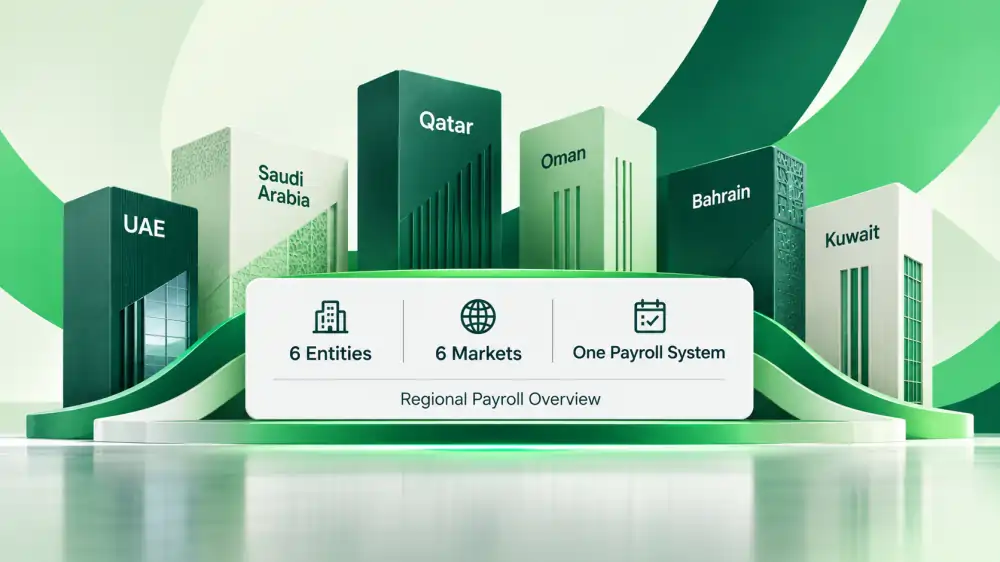
As businesses expand across the Gulf Cooperation Council (GCC), managing payroll across multiple legal entities and countries becomes increasingly complex. Companies operating in the UAE, Saudi Arabia, Qatar, Oman, Bahrain, and Kuwait often have to manage different employee structures, salary components, statutory requirements, payment timelines, currencies, and reporting processes.
For HR teams, payroll is no longer just about calculating monthly salaries. It involves coordinating country-specific regulations, ensuring accuracy, maintaining employee records, managing financial controls, and ensuring that payroll operations remain consistent across multiple business entities.
For organisations with regional operations, managing multi-entity payroll across GCC countries requires a combination of standardised processes, local compliance knowledge, automation, and reliable workforce data.
This article explores the major challenges HR teams face when managing payroll across GCC markets and practical solutions to simplify regional payroll operations.
Multi-entity payroll management refers to the process of administering employee compensation for multiple legal entities, subsidiaries, branches, or business units operating within the same country or across different countries.
A business may have separate entities in Dubai, Abu Dhabi, Riyadh, Doha, Muscat, Manama, or Kuwait City, each with its own employees, financial structures, employment contracts, and regulatory obligations.
Although the organisation may operate under a single corporate structure, payroll requirements can differ significantly between entities.
HR and finance teams must coordinate:
• Employee salary calculations and payroll cycles
• Country-specific employment regulations
• Allowances, deductions, bonuses, and reimbursements
• Employee transfers between legal entities
• Payroll approvals and financial reporting
• Currency and bank payment requirements
• Employee benefits and end-of-service obligations
• Payroll data security and confidentiality
The challenge is to maintain regional visibility and operational consistency without overlooking the legal and administrative requirements of individual countries.
The GCC continues to attract businesses across industries, including retail, construction, manufacturing, logistics, financial services, hospitality, technology, and professional services.
As companies expand, their workforce structures become more diverse. A business may employ expatriates, local nationals, contract workers, executives, project-based employees, and employees working under different subsidiaries.
This creates additional payroll complexity.
Each GCC country operates under its own employment regulations, payroll obligations, and administrative frameworks.
HR teams must understand the applicable requirements relating to employment contracts, salary payments, employee benefits, deductions, leave entitlements, termination settlements, and other statutory obligations.
A process that works for one country may not necessarily be appropriate for another.
For example, payroll administration in the UAE may involve requirements associated with the Wage Protection System (WPS), while businesses operating in Saudi Arabia must consider applicable wage protection and employment compliance frameworks.
Similarly, organisations operating in Qatar, Oman, Bahrain, and Kuwait must account for their respective employment regulations and payroll-related obligations.
Solution: Establish a country-specific payroll compliance framework. Maintain a central compliance calendar, document local requirements, assign responsibility to regional payroll specialists, and review regulatory updates regularly.
Companies operating multiple subsidiaries often have employees distributed across different legal entities, even when those employees perform similar roles or work within the same region.
Each entity may have different:
• Salary structures
• Cost centres
• Approval hierarchies
• Employment contracts
• Payroll policies
• Reporting requirements
• Bank accounts
• Financial accounting procedures
Managing these structures manually can create inconsistencies and increase the risk of payroll errors.
Solution: Create a unified payroll operating framework that standardises core processes while allowing individual entities to maintain their unique payroll configurations, approval workflows, reporting requirements, and statutory rules.
This approach enables HR teams to maintain central oversight without compromising local requirements.
Many organisations still maintain employee information across spreadsheets, disconnected applications, email communications, and separate payroll databases.
This fragmented approach can create problems such as:
• Duplicate employee records
• Incorrect salary information
• Missing employee documentation
• Delayed payroll inputs
• Inconsistent employee classifications
• Difficulty consolidating payroll information
• Limited visibility into payroll status across entities
When payroll data is distributed across multiple sources, HR teams spend valuable time validating and reconciling information before payroll processing can begin.
Solution: Centralise workforce information within a connected HR platform. Maintain a single source of truth for employee details, salary structures, organisational hierarchy, employment status, and payroll-related information, with appropriate access controls for each entity.
Payroll schedules may differ between countries, entities, and employee groups.
HR teams must coordinate payroll cut-off dates, salary calculation timelines, approval deadlines, bank submission schedules, and statutory payment requirements.
A delay in collecting employee attendance, overtime, variable compensation, or approved reimbursements can affect the entire payroll cycle.
When several entities are processed simultaneously, the workload can increase significantly.
Solution: Implement a regional payroll calendar that defines deadlines for each entity. Automate reminders for payroll inputs, approval requests, salary changes, and processing milestones. Establish clear cut-off dates and escalation procedures for incomplete payroll information.
Companies operating across GCC countries may process employee compensation in different currencies, depending on the applicable employment arrangements and payment requirements.
Regional finance teams may also need consolidated payroll reports in a common reporting currency.
This creates additional requirements relating to exchange-rate consistency, payroll reconciliation, budgeting, cost allocation, and financial reporting.
Solution: Establish standard regional reporting practices. Maintain entity-level payroll reporting in the appropriate local currency while providing consolidated dashboards and reports using defined exchange-rate policies for regional management.
This helps finance leaders understand payroll expenditure across countries and business units.
Employee mobility is increasingly common in regional organisations.
Employees may transfer between Dubai and Riyadh, move from one subsidiary to another, relocate to a different GCC country, or take on assignments across multiple markets.
These movements can affect employment contracts, salary structures, employee benefits, leave balances, payroll records, and end-of-service calculations.
Without proper documentation and coordination, employee transfers can result in duplicate records, inaccurate payroll processing, or incorrect final settlements.
Solution: Create a structured employee transfer workflow. Ensure that HR teams document the transfer date, new legal entity, compensation changes, employment status, benefits, leave balances, and applicable payroll treatment before the transfer is processed.
Payroll errors can affect employee satisfaction, financial accuracy, and regulatory compliance.
Common issues include incorrect salary calculations, duplicate payments, unapproved salary changes, inaccurate deductions, missing allowances, and incomplete payroll records.
When payroll is processed across multiple entities, identifying the source of an error can become difficult without proper documentation and audit trails.
Solution: Introduce a payroll validation framework that includes automated checks, maker-checker approvals, reconciliation reports, variance analysis, and documented sign-offs.
Every payroll cycle should have clear accountability and traceability.
Different country regulations
Country-specific compliance rules and calendars
Multiple legal entities
Configurable entity-level payroll structures
Fragmented employee information
Centralised workforce records
Delayed payroll inputs
Automated cut-off reminders and workflows
Currency differences
Standardised regional financial reporting
Employee transfers
Structured entity transfer processes
Payroll errors
Automated validations and reconciliation
Limited regional visibility
Consolidated payroll dashboards
Manual approvals
Digital approval workflows
Audit and compliance risks
Role-based access and audit trails
Standardisation is one of the most effective ways to improve payroll operations across multiple GCC entities.
However, standardisation does not mean applying identical payroll rules to every country.
Instead, organisations should standardise the processes that can be shared across the region while maintaining country-specific requirements where necessary.
Step 1: Map Every Entity and Its Payroll Requirements
Start by identifying all legal entities, employee categories, payroll cycles, salary components, payment processes, and statutory obligations.
Create an entity-level payroll matrix to document differences and similarities across countries.
This gives HR and finance teams a clear understanding of the existing payroll environment.
Step 2: Define Regional Payroll Policies
Establish common policies for payroll input deadlines, salary change approvals, payroll validation, employee data updates, reporting, and escalation procedures.
Clearly define which decisions are managed regionally and which are handled by local HR or payroll teams.
Step 3: Automate Payroll Inputs and Approvals
Manual payroll inputs can increase the likelihood of errors and delays.
Automate processes wherever possible, including:
• Salary revisions
• Variable compensation
• Overtime and additional hours
• Employee reimbursements
• Leave-related payroll adjustments
• New employee payroll setup
• Employee separation processing
• Payroll approval workflows
Automation helps reduce repetitive work and improves process consistency.
Step 4: Build Centralised Payroll Reporting
Regional HR leaders and finance teams need a consolidated view of payroll operations.
Useful reporting metrics include:
• Total payroll expenditure by country
• Payroll cost by legal entity
• Employee headcount by entity
• Payroll processing status
• Salary variance compared with previous months
• Overtime and variable compensation expenditure
• Payroll errors and corrections
• Pending approvals and exceptions
Consolidated reporting helps organisations make better workforce planning and budgeting decisions.
Step 5: Establish Strong Governance and Access Controls
Payroll information contains highly confidential employee data.
Organisations should implement appropriate access controls to ensure that employees, managers, HR teams, payroll specialists, and finance teams can access only the information required for their roles.
Governance should also include:
• Approval hierarchies
• Segregation of responsibilities
• Documented payroll procedures
• Secure employee information handling
• Audit trails
• Periodic access reviews
• Payroll reconciliation controls
A well-defined governance framework improves accountability and reduces operational risk.
As businesses expand across multiple GCC countries, managing payroll through disconnected systems and manual spreadsheets becomes increasingly difficult to scale.
Modern HCM platforms can help organisations bring employee information, payroll workflows, organisational structures, approvals, and reporting into a connected environment.
The right technology can support HR teams by helping them:
• Manage employees across multiple legal entities
• Maintain country-specific salary structures
• Configure payroll-related workflows
• Integrate attendance and leave information
• Automate payroll inputs and approvals
• Track employee movements between entities
• Generate consolidated workforce reports
• Improve payroll data visibility
• Reduce manual administrative work
Technology should not replace local payroll expertise. Instead, it should enable HR and finance teams to manage regional operations more efficiently while retaining the flexibility required for country-specific payroll processes.
For organisations operating across multiple GCC markets, managing employee information and payroll-related processes through disconnected systems can create unnecessary complexity.
WorkPlus HCM helps organisations streamline workforce administration through connected HR processes, centralised employee information, structured workflows, and improved visibility across business entities.
With a more connected approach, HR teams can reduce manual coordination, improve data consistency, simplify approvals, and maintain better oversight of workforce operations across different locations.
A centralised platform can also help HR and finance teams access meaningful employee and payroll-related information for reporting, workforce planning, and operational decision-making.
As regional organisations continue to grow, having a scalable workforce management framework becomes increasingly important for maintaining efficiency and supporting business expansion.
Organisations looking to improve regional payroll operations should consider the following best practices:
1. Maintain country-specific compliance documentation
Document applicable labour regulations, salary payment requirements, employment obligations, and payroll-related deadlines for every country in which the organisation operates.
2. Standardise payroll processes wherever possible
Create common regional procedures for payroll inputs, approvals, reconciliation, reporting, and employee data management.
3. Reduce manual data entry
Automate repetitive administrative processes and minimise reliance on spreadsheets and disconnected employee records.
4. Establish clear payroll ownership
Define responsibilities between regional HR, local HR, payroll teams, finance departments, and business managers.
5. Implement payroll validation controls
Use variance checks, approval workflows, reconciliation procedures, and exception reporting to improve payroll accuracy.
6. Review payroll processes regularly
Conduct periodic reviews to identify inefficiencies, compliance gaps, recurring errors, and opportunities for automation.
7. Invest in scalable technology
Choose a platform capable of supporting multiple entities, growing employee populations, flexible workflows, and consolidated reporting.
Multi-entity payroll is the process of managing employee compensation across multiple legal entities, subsidiaries, branches, or business units. Each entity may have different employee records, salary structures, approval requirements, financial reporting processes, and compliance obligations.
Payroll management across GCC countries is challenging because each country has its own employment regulations, administrative requirements, payment frameworks, employee benefit structures, and operational practices. Organisations must maintain consistency across their regional operations while ensuring that each entity follows applicable local requirements.
Companies can simplify regional payroll operations by centralising employee information, standardising payroll processes, automating approvals, maintaining country-specific compliance calendars, implementing validation controls, and using consolidated reporting.
HR teams should consider local employment regulations, employee classifications, salary structures, payroll schedules, currencies, benefits, approval hierarchies, employee transfers, data security, reporting requirements, and reconciliation procedures.
Yes, core payroll processes can be standardised, including data collection, approvals, validation, reconciliation, reporting, and governance. However, country-specific payroll rules and employment requirements should remain configurable to meet local obligations.
Automation reduces repetitive manual work, improves the consistency of payroll inputs, helps enforce approval procedures, minimises data-entry errors, supports timely processing, and provides better visibility into payroll operations.
Managing payroll across multiple GCC countries requires more than a standard monthly salary calculation process. HR and finance teams must coordinate different legal entities, country-specific regulations, employee structures, payroll timelines, currencies, approvals, and reporting requirements.
As regional businesses grow, relying on manual processes and disconnected employee records can make payroll operations increasingly difficult to manage.
A combination of standardised processes, local compliance expertise, structured governance, automation, and connected workforce technology can help organisations improve payroll accuracy, operational efficiency, and regional visibility.
For HR teams managing a growing GCC workforce, the goal should be to create a scalable payroll framework that supports business expansion while keeping employee administration accurate, consistent, and compliant.
WorkPlus HCM helps organisations build more connected workforce operations, simplify HR administration, and support greater visibility across multiple business entities and regional teams.