2. Understanding AI-Powered HR Assistants
3. Why UAE Businesses Are Adopting Intelligent Employee Support
4. How AI Assistants Improve the Employee Self-Service Experience
5. The Role of Natural Language Processing in HR Automation
6. How AI Assistants Reduce the Administrative Workload of HR Teams
7. AI-Powered Employee Onboarding and New-Hire Assistance
8. Supporting a Multicultural Workforce Across the UAE
9. The Importance of AI Integration With Existing HR Platforms
10. Data Security and Employee Privacy: A Major Consideration for UAE Businesses
11. How AI Assistants Can Support UAE Employment Compliance
12. Personalised Employee Experiences Through Artificial Intelligence
13. AI Assistants and Employee Engagement
14. Practical Examples of AI-Powered HR Assistance in Different UAE Industries
15. Common Challenges Businesses Should Consider Before Implementing AI Assistants
16. How to Implement an AI-Powered HR Assistant Successfully
17. Measuring the Business Impact of AI-Powered Employee Assistance
18. The Future of AI-Powered HR Assistance in the UAE
19. Why Workplus HCM Is Relevant to the Future of Intelligent HR Management
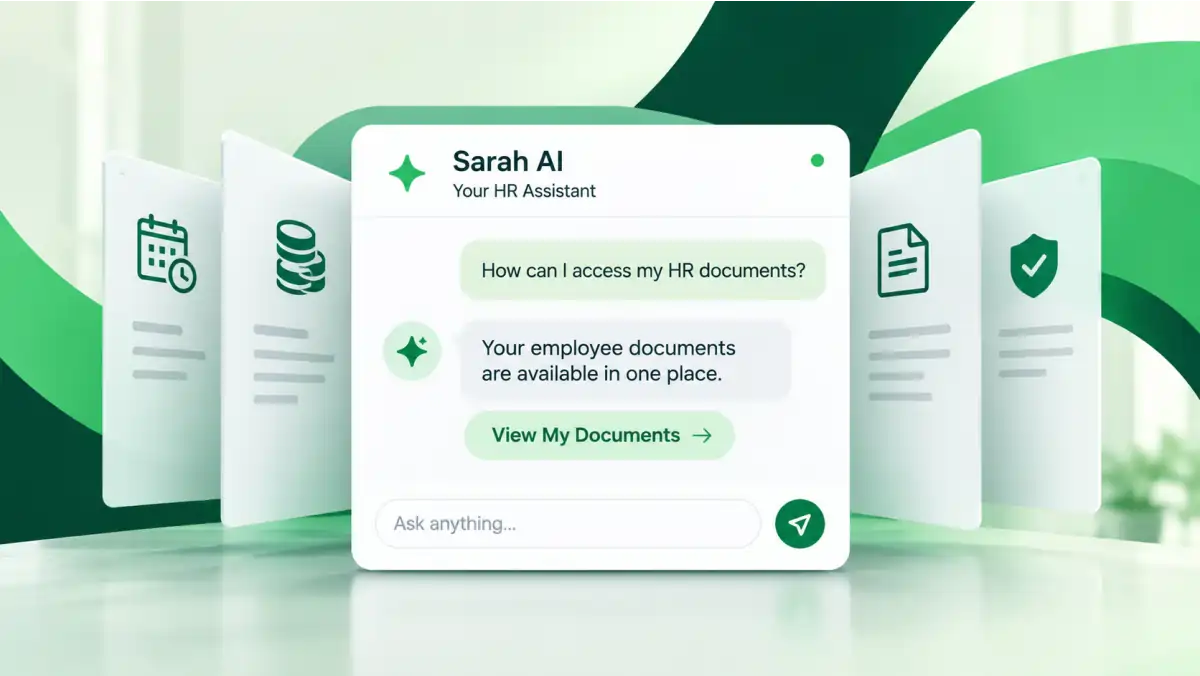
The modern workplace is changing rapidly, and artificial intelligence is becoming an important part of how businesses manage their employees. Across the United Arab Emirates (UAE), organisations are increasingly adopting digital technologies to improve productivity, simplify administrative processes and create better workplace experiences. One of the most significant developments in this transformation is the introduction of AI-powered HR assistants.
Traditionally, employees had to contact their HR departments whenever they needed information about company policies, annual leave, salary details, attendance records, employment documents or workplace procedures. These everyday questions often consumed considerable time for HR professionals, leaving them with fewer opportunities to concentrate on strategic responsibilities such as employee development, workforce planning and organisational growth.
AI-powered HR assistants are changing this experience by providing employees with convenient access to workplace information through intelligent digital conversations. Instead of waiting for an HR representative to respond to routine questions, employees can interact with an AI assistant and receive relevant information within seconds.
For businesses operating in Dubai, Abu Dhabi, Sharjah and other parts of the UAE, this technology offers an opportunity to modernise internal operations while improving employee satisfaction.
Workplus HCM recognises the growing importance of intelligent workplace technology and the role AI can play in making everyday employee interactions simpler, faster and more accessible.
This article explores how AI-powered HR assistants are transforming employee self-service, the benefits they offer UAE organisations, their practical applications, implementation challenges and what businesses should consider when adopting this technology.
An AI-powered HR assistant is a digital tool designed to help employees access workplace information, complete routine HR-related activities and receive assistance through conversational interactions.
Unlike traditional employee portals that require users to navigate several menus and search through different sections, intelligent assistants allow employees to communicate using everyday language.
For example, an employee might ask:
• How many annual leave days do I have remaining?
• When is the next salary payment scheduled?
• How can I download my employment certificate?
• What is the company's maternity leave policy?
• How do I update my personal information?
• Where can I find my latest payslip?
• What should I do if I forget to record my attendance?
The AI assistant interprets the question, identifies the relevant information and provides an appropriate response based on its authorised access to company information and connected HR systems.
Modern solutions may use natural language processing (NLP), machine learning, large language models (LLMs) and intelligent workflow automation to understand requests and provide contextual responses.
The objective is not simply to automate conversations. It is to make workplace support more accessible while reducing unnecessary administrative work.
The UAE has a diverse business environment consisting of multinational corporations, government-related organisations, SMEs, startups, hospitality businesses, retail companies, construction firms and professional service providers.
Many organisations employ people from different nationalities, backgrounds and professional experiences. Managing such a diverse workforce requires efficient communication, accessible information and consistent administrative processes.
Traditional HR communication methods can become difficult to manage when employee numbers increase.
Consider an organisation with 500 employees. Even if every employee raises only one routine HR question each month, the HR department could receive hundreds of individual requests annually.
These requests may include questions about:
• Salary payment dates.
• Leave balances and applications.
• Attendance corrections.
• Company policies.
• Employment documentation.
• Benefits and entitlements.
• Employee information updates.
• Joining formalities.
Responding to these questions individually can create administrative pressure.
AI-powered assistants provide an alternative by making frequently requested information available through a centralised digital interface.
There are several reasons why this approach is becoming increasingly relevant for UAE businesses.
A. A geographically distributed workforce
Some UAE organisations operate across multiple branches, offices, project locations and remote working environments. Employees may not always be physically present near their HR teams.
An AI assistant allows employees to access authorised information without visiting an HR office.
B. Multilingual communication requirements
The UAE workforce includes employees who speak different languages. Businesses may benefit from AI interfaces capable of supporting multiple languages, including English and Arabic.
Language support can make internal communication more accessible, although organisations should ensure that translated employment policies retain their intended meaning.
C. Growing expectations for digital convenience
Employees increasingly expect workplace services to be as convenient as the digital services they use in their personal lives.
Being able to request a document or check a leave balance through a conversational interface can improve the overall employee experience.
D. Greater operational efficiency
By automating repetitive enquiries, HR teams can dedicate more time to activities that require human judgement, personal interaction and business understanding.
Employee self-service gives individuals the ability to access and manage relevant employment information without depending entirely on HR representatives.
AI makes this experience more interactive.
Instead of searching through multiple pages, employees can simply describe what they need.
Here are some important ways intelligent assistants improve everyday workplace interactions.
3.1 Instant Answers to Common HR Questions
One of the biggest advantages of an AI assistant is its ability to answer frequently asked questions.
Employees regularly need clarification about company procedures, workplace policies, attendance requirements and employment benefits.
Without an intelligent support system, HR professionals may spend considerable time responding to similar questions repeatedly.
An AI assistant can provide answers based on approved company documentation and relevant employee information.
For example, an employee asking about the company's annual leave policy can receive an explanation of the applicable rules and instructions for submitting a request.
This reduces unnecessary communication delays and helps employees find information independently.
However, sensitive or complicated enquiries should be transferred to an authorised HR professional rather than answered through an unsupported AI-generated assumption.
3.2 Simplifying Leave Requests
Leave administration is one of the most common interactions between employees and HR departments.
Employees may want to understand their available leave balance, check applicable eligibility requirements or submit a request for upcoming holidays.
An AI-powered assistant can guide employees through these activities.
A typical interaction could look like this:
Employee: I would like to apply for three days of annual leave next month.
AI Assistant: Please provide your preferred dates. I can guide you through the company's leave request process.
Once the employee provides the required details, the assistant may initiate a workflow connected to the organisation's HR platform.
The employee can subsequently receive updates about the request, subject to the system's configured approval process.
This makes routine administrative interactions more convenient and transparent.
3.3 Easy Access to Salary Information
Salary-related enquiries are another important part of employee support.
Employees frequently want to know when salaries are processed, where they can access their payslips and how to obtain salary-related documents.
An intelligent assistant connected to authorised payroll records can help employees locate their latest payslip or understand where to find relevant salary information.
For UAE organisations, salary administration may also involve the Wage Protection System (WPS), where applicable.
AI assistants can guide employees towards relevant payroll information and explain general procedures. However, salary calculations, payment approvals and regulatory submissions must remain subject to appropriate payroll controls and human oversight.
Access to confidential salary information should always require proper identity verification and role-based permissions.
3.4 Managing Attendance-Related Enquiries
Employees may occasionally forget to record their working hours, encounter technical problems while checking in or need clarification about attendance procedures.
An AI assistant can help explain the correct process and guide employees towards the appropriate correction workflow.
For example:
• How do I report a missed check-in?
• What should I do if my attendance record is incorrect?
• Where can I view my working hours?
• Who approves attendance corrections?
If connected to an attendance management platform, the assistant may also help employees access their individual records.
This reduces repetitive enquiries while encouraging employees to take greater responsibility for maintaining accurate information.
3.5 Downloading Employment Documents
Employees often require official documents for banking, rental applications, travel arrangements and other personal or professional requirements.
These may include:
• Employment certificates.
• Salary certificates.
• Payslips.
• Employment contracts.
• Leave records.
• Other authorised employee documents.
An AI assistant can explain how to request or retrieve these documents.
Depending on system integration and organisational permissions, certain documents may also be generated automatically through an established workflow.
This eliminates unnecessary back-and-forth communication and makes document access more convenient.
Natural Language Processing is one of the technologies that makes conversational HR assistance possible.
Traditional software generally requires employees to follow predefined navigation paths. NLP enables an intelligent system to understand questions written in ordinary language.
For example, consider these three questions:
• How much leave do I have?
• Can you check my remaining holidays?
• What is my current annual leave balance?
Although the wording is different, all three questions communicate a similar requirement.
An NLP-powered assistant can identify the employee's intention and direct the request to the relevant information source.
More advanced systems can also maintain conversational context.
An employee might first ask about their remaining leave and then follow up with, "Can I use five of those days next month?"
The assistant can use the previous interaction to understand the context instead of treating the second question as an entirely separate enquiry.
This creates a more natural communication experience.
However, the quality of responses depends on the accuracy of underlying company information, the design of the conversational workflow and the permissions granted to the AI system.
HR professionals perform many responsibilities beyond answering employee questions.
Their work may include recruitment coordination, employee relations, workforce planning, performance discussions, learning and development, compliance administration and organisational policy management.
When HR teams spend a significant proportion of their working hours responding to repetitive questions, strategic activities may receive less attention.
AI-powered assistants can reduce this burden in several ways.
5.1 Automating Repetitive Enquiries
Questions about leave balances, salary documents, attendance procedures and company policies often follow predictable patterns.
An AI assistant can handle approved, frequently asked questions without requiring an HR representative to respond individually every time.
5.2 Reducing Internal Email Communication
Many routine employee requests are handled through email.
This creates additional work because HR professionals must read incoming messages, identify the requirement, locate the relevant information and prepare a response.
Conversational support can reduce the number of emails generated for straightforward requests.
5.3 Improving Response Consistency
When different HR representatives answer similar questions, employees may occasionally receive inconsistent explanations.
A properly configured AI assistant can refer to approved company policies and standardised information.
This helps organisations maintain consistent communication across departments and locations.
5.4 Allowing HR Teams to Focus on Strategic Activities
By reducing routine administrative interactions, HR professionals can spend more time understanding workforce requirements, improving employee retention, developing talent and supporting business objectives.
The real value of AI is therefore not simply reducing manual work. It is helping HR departments concentrate on responsibilities where human judgement and expertise matter most.
The first few weeks of employment can significantly influence how new employees perceive an organisation.
New hires generally have numerous questions about workplace procedures, company policies, reporting structures, documentation requirements and internal communication channels.
An AI assistant can act as a digital guide throughout the initial employment experience.
For example, new employees may ask:
• Where can I find the employee handbook?
• How do I access my company account?
• What are the office working hours?
• Who should I contact for technical assistance?
• Where can I find information about company benefits?
• How do I complete my joining formalities?
The assistant can provide relevant instructions and direct employees towards the appropriate resources.
Organisations may also configure automated reminders for pending documentation, introductory training and other onboarding activities.
For businesses hiring employees throughout the year, this can help create a more organised and consistent joining experience.
An important consideration is that onboarding involves personal interaction as well as administrative tasks. AI should complement the support provided by managers, colleagues and HR professionals rather than replace it.
One of the defining characteristics of the UAE employment market is its multicultural workforce.
Employees may come from India, Pakistan, the Philippines, Egypt, the United Kingdom, Nepal and many other countries.
This diversity creates opportunities for businesses but also introduces communication challenges.
An AI assistant with multilingual capabilities can help employees interact with workplace systems in a language they understand.
For example, an employee who is more comfortable communicating in Arabic may prefer asking a question in Arabic rather than English.
Similarly, another employee may prefer English or another supported language.
Multilingual assistance can help improve accessibility by:
• Providing translated explanations of approved policies.
• Guiding employees through routine administrative processes.
• Helping employees understand workplace instructions.
• Making internal information easier to access.
• Reducing communication barriers between employees and administrative teams.
Businesses must ensure that AI-generated translations are reviewed where legal, contractual or employment-related accuracy is important.
This is particularly relevant when communicating information about contractual obligations, employee entitlements and official company policies.
An AI assistant becomes significantly more useful when it can securely communicate with the organisation's existing digital systems.
A standalone chatbot may answer general questions, but it cannot reliably provide individual employee information unless it is connected to the appropriate data sources.
For example, checking an employee's leave balance requires access to the relevant leave records.
Similarly, retrieving a payslip requires a connection to authorised payroll information.
Businesses should therefore consider the following integration requirements:
Employee information systems: To retrieve authorised employee details and organisational information.
Payroll platforms: To provide access to approved salary records and payslip information.
Attendance systems: To help employees access working-hour records and attendance procedures.
Leave administration tools: To support leave balance enquiries and application workflows.
Document management systems: To retrieve approved employment documents.
Communication platforms: To make assistance accessible through supported digital channels.
The integration process should follow secure authentication procedures, data access restrictions and appropriate audit controls.
Workplus HCM aims to support businesses in understanding the value of connected workforce technology and how intelligent assistance can contribute to a more streamlined employee experience.
AI adoption in HR requires careful attention to employee privacy and information security.
HR departments handle confidential information, including personal details, salary records, employment documentation, contact information and other sensitive workplace data.
Introducing AI into these processes creates additional responsibilities.
Businesses should establish clear guidelines before allowing an AI assistant to access employee information.
Important considerations include:
Role-Based Access Control
Employees should only be able to retrieve information they are authorised to view.
For example, an employee should not be able to access another employee's salary records simply by asking the AI assistant.
Secure Authentication
The system should verify employee identity before providing access to confidential records or initiating sensitive requests.
Data Protection Policies
Businesses should understand how employee information is collected, processed, stored and shared by the AI solution.
Audit Trails
Organisations should maintain appropriate records of sensitive information requests, system actions and administrative approvals.
Human Oversight
AI-generated answers should not independently determine complex employment decisions or override approved company procedures.
UAE Regulatory Considerations
Businesses operating in the UAE should consider applicable data protection requirements, including Federal Decree-Law No. 45 of 2021 on the Protection of Personal Data, where applicable.
Organisations operating in the DIFC or ADGM should also assess the separate data protection frameworks relevant to their jurisdictions.
Companies should consult qualified legal and information security professionals to ensure that their AI implementation complies with applicable requirements.
Responsible AI adoption requires transparency, accountability and appropriate safeguards.
Employment administration in the UAE involves various regulatory and procedural requirements.
Businesses need to maintain accurate employee records, communicate applicable policies and ensure that their internal processes follow relevant employment regulations.
AI assistants can help employees understand approved workplace procedures and locate relevant information.
For example, employees may ask about:
• Annual leave eligibility.
• Sick leave procedures.
• Maternity and parental leave information.
• Working-hour policies.
• Employment documentation.
• End-of-service benefit procedures.
• Salary payment processes.
• Workplace grievance procedures.
An AI assistant can direct employees towards approved company policies and relevant official information.
It may also help HR teams make frequently requested information more accessible.
However, there is an important distinction between explaining regulations and determining legal compliance.
AI should not independently interpret complex employment disputes, calculate final employee entitlements without validated rules or make binding legal decisions.
Businesses should ensure that regulatory information is reviewed periodically and that complicated cases are escalated to qualified HR or legal professionals.
Another major development in AI-enabled workplace support is personalisation.
Traditional employee portals may present the same information to every user, regardless of their department, location, designation or employment circumstances.
An intelligent assistant can provide more relevant responses by using authorised employee context.
For example:
An employee working in Dubai may need information about a particular office's working arrangements.
An employee working on a project site may require different attendance instructions.
A newly recruited employee may need guidance about joining formalities.
A manager may require information about team-related approval responsibilities.
With appropriate access permissions, AI can identify the user's context and direct them towards relevant information.
This creates a more personalised experience while reducing the need for employees to navigate unrelated content.
However, personalisation should remain transparent and should not rely on unnecessary collection of personal information.
Employee engagement is influenced by several factors, including communication, management support, workplace culture, recognition and access to information.
While an AI assistant cannot replace effective leadership or meaningful human relationships, it can contribute to a better everyday employee experience.
Employees may become frustrated when they cannot find answers to basic questions or have to wait several days for routine administrative assistance.
Providing convenient access to information can reduce these frustrations.
AI assistants may also support engagement by helping employees:
• Understand company policies.
• Access workplace resources.
• Find learning and development information.
• Submit feedback through approved channels.
• Locate internal support services.
• Receive reminders about important workplace activities.
Organisations can use aggregated and appropriately anonymised interaction data to identify recurring employee concerns.
For example, if employees repeatedly ask about a particular workplace policy, HR may discover that the policy needs clearer communication.
This allows organisations to improve internal processes based on actual employee information needs.
Employee engagement, however, requires more than technology. Managers must continue listening to employees, addressing concerns and creating a supportive working environment.
The usefulness of intelligent employee support varies depending on the organisation's workforce structure and business activities.
Here are some examples of how different UAE industries can benefit.
Banking and Financial Services
Financial institutions generally have structured administrative procedures and extensive documentation requirements.
AI assistants can help employees locate approved HR policies, understand internal procedures and access authorised employment documents.
Because financial organisations handle sensitive information, strong security and access controls are essential.
Hospitality and Tourism
Hotels, restaurants and tourism businesses frequently operate across multiple shifts and departments.
Employees may require assistance with attendance procedures, shift-related information, leave requests and workplace policies.
An AI assistant can make these routine enquiries easier to manage.
Construction and Engineering
Construction organisations may employ large workforces across different project sites.
Employees and supervisors may need access to company procedures, attendance instructions and administrative support.
Digital assistance can help make relevant information accessible across locations.
Retail and E-commerce
Retail businesses often operate multiple outlets with employees working different shifts.
AI assistants can help employees access workplace information, understand leave procedures and retrieve relevant documents.
Healthcare
Healthcare organisations have complex staffing requirements and operate across different departments and shifts.
Intelligent assistance can help administrative employees locate approved policies and complete routine HR-related requests.
Confidentiality and appropriate access restrictions are particularly important in this environment.
Information Technology
Technology businesses often have digitally connected workforces and employees who are comfortable using conversational interfaces.
AI assistants can help employees find internal documentation, request employment records and access workplace support services.
Although AI offers considerable opportunities, successful implementation requires proper planning.
Businesses should not assume that introducing a chatbot automatically improves HR operations.
Several challenges need to be addressed.
Inaccurate or Outdated Information
An AI assistant is only as useful as the information available to it.
If company policies, employment records or internal documents are outdated, employees may receive incorrect responses.
Organisations should establish a process for regularly reviewing and updating the information used by the assistant.
Lack of System Integration
A chatbot that cannot connect to relevant employee information systems may provide limited value.
Businesses should evaluate integration capabilities before selecting a solution.
Employee Adoption
Some employees may be unfamiliar with AI-based workplace assistance.
Organisations should introduce the technology gradually, explain its purpose and provide guidance on how to use it.
Privacy Concerns
Employees may be uncomfortable sharing personal employment information through an AI interface.
Clear communication about data handling, security and privacy is essential.
Complex Employee Queries
Not every HR question can be answered automatically.
Sensitive employee relations matters, contractual disputes and complicated regulatory questions should be transferred to qualified professionals.
Measuring Actual Business Value
Businesses should establish measurable objectives before implementation.
These may include reducing repetitive enquiries, improving response times, increasing employee self-service adoption and reducing administrative processing time.
Monitoring these indicators helps organisations understand whether the technology is delivering meaningful results.
A structured implementation approach can help UAE businesses introduce AI without disrupting existing HR operations.
The following steps provide a practical starting point.
Step 1: Identify Repetitive Employee Enquiries
Start by reviewing the questions HR teams receive most frequently.
Identify recurring requests related to leave, attendance, payroll documents, company policies and employee information.
These are generally suitable starting points for employee self-service automation.
Step 2: Organise Company Information
Review internal policies, employee handbooks, frequently asked questions and other relevant documentation.
Ensure that information is accurate, approved and easy for the AI system to retrieve.
Step 3: Define the Assistant's Responsibilities
Determine which activities the assistant can perform.
For example, it may answer general questions, guide employees through application procedures or retrieve authorised documents.
Define which activities require human approval.
Step 4: Evaluate Integration Requirements
Assess how the AI solution will connect with existing employee information systems, payroll records, attendance platforms and document repositories.
Step 5: Establish Security Controls
Configure employee authentication, access permissions, audit logging and data protection measures.
Step 6: Conduct a Pilot Programme
Introduce the assistant to a small group of employees before making it available across the organisation.
Collect feedback and identify incorrect responses, technical issues and usability challenges.
Step 7: Train Employees
Explain how to interact with the assistant, what information it can provide and when employees should contact HR directly.
Step 8: Monitor Performance
Measure adoption rates, response accuracy, employee satisfaction and the number of enquiries resolved without manual intervention.
Use these insights to improve the system continuously.
To understand whether an AI assistant is delivering value, organisations should track relevant performance indicators.
Some useful metrics include:
Average response time: Measures how quickly employees receive answers to their enquiries.
Self-service resolution rate: Tracks the percentage of eligible enquiries resolved without direct HR intervention.
Employee satisfaction: Measures how employees feel about the accessibility and quality of support.
HR enquiry volume: Helps identify changes in repetitive administrative requests.
Document retrieval time: Measures how quickly employees can access authorised employment documents.
Employee adoption rate: Tracks how frequently employees use the assistant.
Escalation rate: Identifies the proportion of enquiries transferred to human HR representatives.
Businesses should evaluate these indicators before and after implementation.
For example, if an organisation receives 1,000 routine HR enquiries per month, it can monitor how many are successfully resolved through self-service after introducing an AI assistant.
The purpose is to establish measurable improvements rather than relying on assumptions about the benefits of artificial intelligence.
The role of artificial intelligence in workplace administration is expected to expand as organisations become more comfortable integrating intelligent systems into their daily operations.
Future developments may include more advanced conversational experiences, improved multilingual communication, predictive assistance and deeper connections with business applications.
Some emerging possibilities include:
Proactive employee support: Assistants may provide relevant reminders about upcoming administrative deadlines, pending requests and required documentation.
Smarter workflow automation: Employees may be able to complete multiple connected administrative activities through a single conversation.
Improved contextual understanding: AI systems may become better at understanding complex questions and maintaining context across conversations.
Voice-based interactions: Employees may increasingly use voice interfaces to access approved workplace information.
Intelligent knowledge management: AI may help organisations organise large volumes of internal documentation and make relevant information easier to discover.
Advanced workforce insights: Aggregated interaction patterns may help HR departments identify common information gaps and recurring administrative problems.
However, future adoption will depend on trustworthy technology, secure integrations, reliable information and responsible governance.
UAE organisations that approach AI strategically can build a more accessible and efficient employee support environment.
As businesses explore the possibilities of artificial intelligence, selecting the right workforce technology partner becomes increasingly important.
Workplus HCM is focused on helping organisations understand and adopt modern approaches to workforce administration and employee management.
For UAE businesses, the objective should be to create a connected workplace where employees can access relevant information, managers can handle responsibilities efficiently and HR professionals can concentrate on activities that contribute to organisational growth.
Intelligent employee assistance is an important part of this broader transformation.
When implemented effectively, AI-powered support can help businesses reduce repetitive administrative communication, improve information accessibility and create more consistent employee experiences.
Organisations evaluating modern workforce platforms should consider factors such as:
• Ease of use for employees and HR professionals.
• Integration with existing business applications.
• Secure access to confidential employee information.
• Support for relevant workplace processes.
• Flexibility to accommodate organisational growth.
• Reporting and administrative visibility.
• Availability of intelligent automation capabilities.
• Quality of customer support and implementation assistance.
Workplus HCM encourages businesses to look beyond basic digitisation and consider how intelligent technology can improve the everyday experience of employees and HR teams.
The future of workplace administration will increasingly depend on combining reliable digital systems, intelligent assistance and human expertise.
AI-powered HR assistants are changing how employees interact with their organisations.
Instead of depending entirely on HR representatives for routine information, employees can use conversational interfaces to access authorised records, understand company procedures, retrieve documents and receive guidance on everyday administrative activities.
For UAE businesses operating across multiple locations and managing diverse workforces, this approach can improve accessibility, reduce repetitive communication and support more efficient HR operations.
However, successful adoption requires more than implementing an AI chatbot. Businesses must prioritise accurate information, secure system integrations, employee privacy, regulatory awareness and human oversight.
The most effective approach is to use artificial intelligence to complement HR professionals rather than replace them.
As the UAE continues to embrace digital transformation, intelligent employee assistance is becoming an important consideration for organisations looking to build more connected, responsive and employee-friendly workplaces.
Workplus HCM believes that the future of effective workforce management lies in combining intelligent technology with human expertise, enabling businesses to create better experiences for employees while supporting long-term organisational growth.
1. What is an AI-powered HR assistant?
An AI-powered HR assistant is a digital tool that uses artificial intelligence and conversational technology to help employees access workplace information, understand company policies and complete routine administrative activities.
2. How can AI assistants improve employee self-service?
They allow employees to ask questions in natural language and receive relevant information without waiting for an HR representative. They can also guide employees through processes involving leave requests, attendance records and employment documents.
3. Can AI assistants answer employee payroll questions?
Yes. When securely connected to authorised payroll information, an AI assistant can help employees locate payslips, understand general salary procedures and access relevant payroll documents.
4. Are AI-powered HR assistants suitable for small businesses in the UAE?
Yes. Small and medium-sized businesses can use intelligent assistants to reduce repetitive administrative work, improve access to workplace information and provide employees with more convenient support.
5. Can AI assistants communicate in Arabic and English?
Many modern AI solutions support multiple languages, including Arabic and English. Businesses should evaluate language accuracy, translation quality and compatibility with their internal policies before implementation.
6. Can AI assistants manage employee leave requests?
Depending on system integration, an assistant can guide employees through leave applications, retrieve relevant balances and initiate request workflows. Approval decisions should follow the organisation's established procedures.
7. Are AI assistants safe for handling employee information?
They can be used responsibly when supported by secure authentication, role-based permissions, appropriate data protection measures and audit controls. Businesses should evaluate the provider's data handling practices before connecting confidential employee records.
8. Can AI replace HR professionals?
No. AI can automate repetitive enquiries and provide administrative assistance, but HR professionals remain essential for employee relations, complex workplace matters, decision-making, conflict resolution and strategic workforce planning.
9. How does AI help reduce HR administrative costs?
AI can reduce the time spent answering repetitive questions, locating documents and handling routine employee requests. The actual financial benefit depends on implementation costs, employee adoption and the volume of enquiries automated.
10. What should UAE companies consider before implementing an AI assistant?
Businesses should evaluate security, privacy, system integration, language capabilities, information accuracy, employee adoption, workflow automation and compliance with applicable UAE regulations.
11. Can an AI assistant help employees access company policies?
Yes. When connected to approved company documentation, an assistant can help employees locate and understand relevant policies, explain general procedures and direct complicated enquiries to HR.
12. What is the future of AI in employee management?
AI is expected to support more personalised employee interactions, multilingual assistance, intelligent workflows, automated reminders and improved access to workplace information. Human oversight and responsible data management will remain essential.
About Workplus HCM
Workplus HCM focuses on helping organisations modernise workforce administration through digital technology and intelligent workplace solutions. By bringing greater efficiency, accessibility and convenience to everyday employee interactions, businesses can create a more connected workplace and empower HR teams to focus on strategic priorities.
Visit Workplus HCM to explore how modern workforce technology can support your organisation's evolving HR requirements.