November 2, 2026
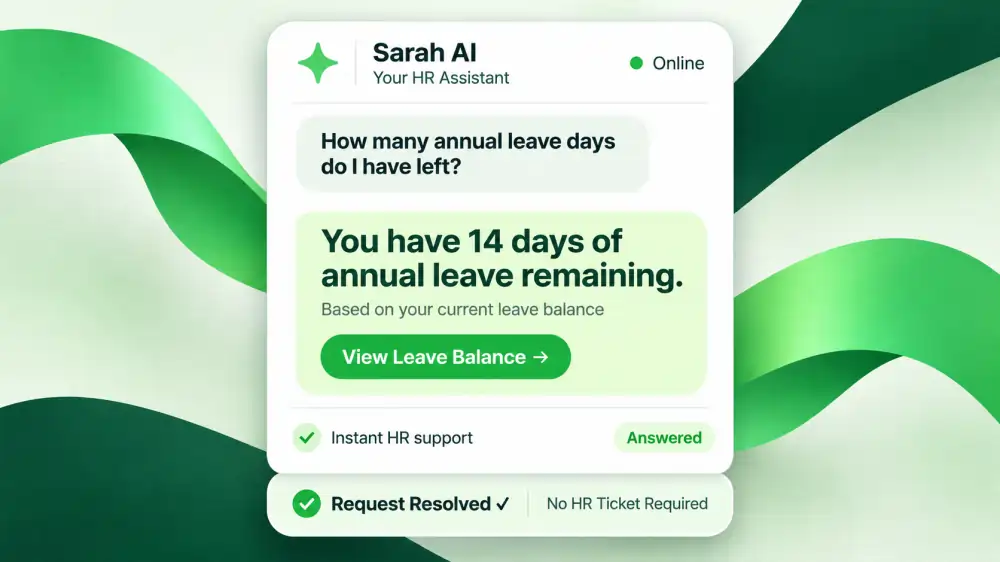
The way organisations manage their employees is changing rapidly. Across the Gulf Cooperation Council (GCC), businesses are embracing digital transformation to improve operational efficiency, enhance employee experiences and reduce the administrative burden on human resources departments. From large enterprises in the UAE and Saudi Arabia to growing businesses in Qatar, Bahrain, Kuwait and Oman, HR teams are increasingly looking for smarter ways to manage everyday employee requests.
One of the most interesting developments in this transformation is the introduction of AI-powered HR assistants.
Imagine an employee who wants to know how many annual leave days they have remaining. Traditionally, they would send an email to the HR department, raise a support request or contact an HR representative directly. Someone from the HR team would then need to locate the employee’s information, verify the details and respond.
Now imagine receiving an accurate answer within seconds through a conversational AI assistant.
This is precisely how AI HR assistants like Sarah are transforming employee support.
Instead of requiring HR professionals to spend hours responding to repetitive questions, an intelligent virtual assistant can handle common employee queries, guide employees through routine processes and provide instant access to relevant workplace information.
For GCC companies managing diverse workforces across multiple locations, nationalities, languages and employment arrangements, this development represents a significant opportunity.
With solutions from Workplus HCM, organisations can explore how intelligent HR automation can simplify employee interactions while allowing HR professionals to concentrate on strategic business priorities.
The GCC business environment has undergone considerable transformation over the last decade. Governments and private organisations across the region are investing in digital infrastructure, artificial intelligence, automation and employee-centric workplace technologies.
Countries such as the United Arab Emirates and Saudi Arabia have placed digital transformation at the centre of their economic development strategies.
As organisations grow, their HR departments face increasing pressure to provide consistent and timely employee support.
Employees expect quick answers. Managers want greater visibility into workforce-related activities. HR professionals need to balance employee engagement, compliance, talent development and administrative responsibilities.
Traditional HR support models often struggle to meet these expectations.
A significant proportion of HR requests involve routine questions, including:
Individually, these questions may appear simple. However, when hundreds or thousands of employees raise similar queries every month, the workload becomes substantial.
This is where AI-powered HR assistants offer a practical solution.
Rather than treating every employee question as a separate manual support request, organisations can introduce an intelligent conversational interface that understands employee questions and provides relevant responses.
Sarah represents this new generation of intelligent employee support.
An AI HR assistant is a digital workplace companion designed to help employees access HR information and complete routine HR-related activities through natural conversations.
Unlike traditional automated chatbots that depend heavily on predefined questions and answers, modern AI assistants can use natural language processing and artificial intelligence to understand the intent behind employee queries.
For example, an employee might ask:
“I need to take three days off next week. How do I apply?”
Another employee might phrase the same request differently:
“Can you tell me how to request leave for Monday to Wednesday?”
An intelligent assistant can recognise that both employees are asking about the leave application process.
Depending on its configuration and system permissions, Sarah can guide employees through the relevant process, retrieve authorised information and help them find the right next step.
The objective is not simply to automate conversations. It is to make everyday HR interactions easier, faster and more accessible.
An AI HR assistant can become a central access point for employees who need information about company policies, payroll-related queries, attendance, leave, onboarding and other workplace processes.
For organisations operating across the GCC, this can be particularly valuable because employees may be distributed across multiple offices, business units and geographical locations.
Several factors are contributing to the increasing interest in AI-driven employee support across the Gulf region.
GCC countries have highly diverse workforces comprising employees from different nationalities, professional backgrounds and cultural environments.
A company operating in Dubai, Abu Dhabi, Riyadh or Doha may have employees working across different departments, locations and shifts.
Managing employee queries through traditional communication channels can become difficult as the workforce expands.
AI HR assistants offer a more scalable approach.
Employees can access information through a central conversational interface rather than depending entirely on HR representatives to respond individually.
Modern employees are accustomed to receiving information immediately.
They use digital applications for banking, shopping, travel and communication. Naturally, they expect workplace interactions to be equally convenient.
Waiting several hours or even days for a basic HR response can create frustration.
An AI-powered assistant can provide immediate answers to frequently asked questions, subject to the availability of accurate and approved company information.
This improves accessibility and reduces unnecessary communication delays.
HR teams are responsible for much more than responding to employee questions.
Their responsibilities include:
When HR professionals spend a considerable portion of their working hours handling repetitive enquiries, they have less time for activities that contribute directly to organisational growth.
Automating routine interactions can help restore this balance.
Digital transformation is a major priority across the GCC.
The UAE’s national digital initiatives and Saudi Arabia’s Vision 2030 demonstrate the region’s commitment to technology-driven economic development.
Businesses are increasingly evaluating how artificial intelligence can improve productivity, streamline operations and create better employee experiences.
HR is an important part of this transformation because almost every employee interacts with HR processes throughout their employment journey.
The biggest advantage of an AI HR assistant is its ability to reduce the need for manual intervention in repetitive employee support activities.
Let’s examine some practical examples.
Employees frequently contact HR to clarify company policies.
These questions may relate to annual leave, sick leave, attendance, working hours, workplace conduct, travel policies and other internal guidelines.
Without an intelligent support system, HR teams must repeatedly locate and share the same information.
Sarah can serve as a conversational access point to approved company policy documents.
For example, an employee could ask:
“What is the company’s annual leave policy?”
The assistant can retrieve the relevant information from its authorised knowledge base and provide a clear response.
If the employee needs additional clarification, the assistant can guide them towards the appropriate HR representative.
This reduces repetitive enquiries while helping employees access consistent information.
Leave-related questions are among the most common interactions between employees and HR departments.
Employees often want to understand their leave balance, application procedures, approval status and applicable leave policies.
Sarah can help employees navigate these processes by answering relevant questions and guiding them through the appropriate workflow.
Where authorised system integrations are available, the assistant may also retrieve employee-specific information.
For example:
“How many annual leave days do I have available?”
Instead of sending an email and waiting for a response, an employee may receive the information directly through the assistant.
The exact functionality depends on the organisation’s HR platform, integration capabilities and access permissions.
Salary-related questions can generate a substantial volume of employee communication.
Common enquiries include:
An AI HR assistant can help employees locate payroll information, understand standard procedures and identify the correct support channel.
For sensitive matters, the assistant should follow strict access controls and direct complex or disputed cases to authorised payroll professionals.
This distinction is important.
Artificial intelligence should simplify payroll communication without compromising the confidentiality of employee financial information.
Attendance management is another area where repetitive employee questions are common.
Employees may need help understanding attendance policies, correcting missed punches, checking working hours or reporting attendance discrepancies.
Sarah can provide guidance on approved attendance procedures and explain how employees should raise relevant requests.
For example:
“I forgot to mark my attendance yesterday. What should I do?”
The assistant can explain the company’s correction process and direct the employee to the relevant workflow.
This makes it easier for employees to resolve routine attendance-related concerns without unnecessary email exchanges.
The employee experience begins before the first working day.
New employees typically have several questions about joining formalities, documentation, company policies, workplace access and reporting procedures.
HR teams often spend considerable time answering similar questions for every new employee.
An AI assistant can provide a more structured onboarding experience.
Sarah can guide new employees through questions such as:
By making essential information easily accessible, organisations can create a smoother onboarding journey.
It also allows HR professionals to spend more time building relationships with new employees rather than repeatedly sharing administrative instructions.
Employees frequently require access to standard workplace documents.
These may include employment letters, company policies, internal forms, salary certificates and other official records.
Without a centralised information system, employees may need to contact different HR representatives to locate the required documents.
An AI HR assistant can help employees understand where documents are available and how to request them.
Where the required integration and permissions exist, the assistant can also guide employees towards secure document retrieval processes.
This reduces unnecessary back-and-forth communication.
One of the biggest challenges for organisations with shift-based operations is providing consistent HR support outside regular office hours.
Industries such as hospitality, healthcare, retail, construction, logistics and manufacturing often operate beyond conventional working hours.
Employees working evening, night or rotating shifts may need HR information when the HR department is unavailable.
An AI assistant can provide access to approved information beyond traditional office hours.
For example, an employee working a night shift may want to understand the company’s attendance policy or check the process for reporting an absence.
Instead of waiting until the next working day, the employee can access the relevant guidance immediately.
This makes employee support more accessible across different working schedules.
Traditional HR ticketing systems generally work through a request-and-response model.
An employee submits a query, the system records it, and an HR representative reviews and responds to the request.
Although this approach is useful for tracking complex issues, it can create unnecessary administrative work when applied to simple questions.
AI HR assistants introduce a more conversational and proactive support model.
Consider the following comparison:
| Area | Traditional HR Support | AI HR Assistant |
|---|---|---|
| Employee queries | Manual requests | Conversational interactions |
| Response time | Depends on HR availability | Immediate for supported queries |
| Routine questions | Repeated manual responses | Automated responses |
| Policy information | Shared manually | Retrieved from approved knowledge sources |
| Employee accessibility | Depends on support hours | Can be available beyond office hours |
| HR workload | Higher repetitive workload | Reduced routine enquiries |
| Complex cases | HR intervention required | Escalation to authorised HR personnel |
| Scalability | Requires additional support capacity | Can support growing employee volumes |
The most effective approach is not necessarily to eliminate HR ticketing altogether.
Instead, businesses should distinguish between routine enquiries and cases that genuinely require human judgement.
AI can handle straightforward information requests, while HR professionals focus on employee relations, sensitive matters, investigations and complex workplace decisions.
Introducing an AI HR assistant is not simply a technology upgrade. It can influence employee satisfaction, operational efficiency and the overall effectiveness of HR operations.
HR departments often spend valuable time answering repetitive questions.
When employees can independently access reliable information, the number of routine enquiries requiring manual responses can decrease.
This allows HR professionals to concentrate on more important responsibilities.
Employees appreciate quick and accurate responses.
An AI assistant can provide instant guidance for common enquiries without requiring employees to wait for an HR representative.
Faster access to information can improve the overall employee experience.
A positive employee experience is influenced by several factors, including communication, accessibility, transparency and convenience.
When employees can easily find information about workplace policies and procedures, everyday interactions become less frustrating.
An intelligent assistant can contribute to a more responsive workplace environment.
HR productivity should not be measured only by the number of employee requests resolved.
It should also consider how much time HR professionals can dedicate to strategic initiatives.
By reducing repetitive administrative work, organisations can give their HR teams more opportunities to focus on workforce planning, employee development and organisational effectiveness.
When multiple HR representatives answer the same questions independently, differences in wording and interpretation can occur.
An AI assistant connected to approved organisational information can provide more consistent answers.
However, maintaining a regularly updated knowledge base remains essential.
As businesses expand into new locations or increase employee headcount, their HR support requirements also grow.
An AI-powered support model can help organisations manage increasing volumes of routine enquiries without relying exclusively on additional administrative resources.
When properly integrated with organisational systems, AI-driven employee support can also provide useful information about recurring employee concerns.
For example, HR leaders may identify that employees frequently ask about:
These patterns can help HR departments identify communication gaps and improve internal processes.
Although AI-powered HR automation is relevant globally, the GCC has several characteristics that make it especially valuable.
The UAE has a highly international workforce, with businesses operating across multiple emirates and industries.
Companies in Dubai, Abu Dhabi, Sharjah and other commercial centres often manage employees from different nationalities and professional backgrounds.
HR departments must ensure that employees can access clear and consistent workplace information.
An intelligent assistant can help simplify communication by providing a central channel for routine HR enquiries.
For growing organisations, this can improve the consistency of employee support while reducing repetitive administrative work.
Saudi Arabia is undergoing significant economic and organisational transformation.
Vision 2030 has encouraged investment in technology, innovation, workforce development and private-sector growth.
As businesses expand and workforce requirements evolve, HR departments must adopt efficient processes that can support larger and more complex organisations.
AI assistants can help simplify employee communication, improve access to workplace information and reduce the administrative burden associated with routine HR interactions.
The opportunity is not limited to the UAE and Saudi Arabia.
Companies in Qatar, Kuwait, Bahrain and Oman also face challenges associated with workforce growth, employee communication and administrative efficiency.
Organisations operating across multiple GCC markets can benefit from centralised employee support, provided their systems are configured to accommodate local employment requirements and company-specific policies.
Although AI HR assistants offer several advantages, successful implementation requires careful planning.
Organisations should not introduce artificial intelligence simply because it is a popular technology trend.
The objective should be to solve real HR challenges.
Here are some important considerations.
An AI assistant is only as useful as the information available to it.
If company policies are outdated, incomplete or contradictory, employees may receive inaccurate responses.
Before implementation, organisations should review their existing HR documentation and ensure that approved information is properly organised.
HR systems contain confidential information, including personal details, employment records, salary information and other sensitive employee data.
Any AI-powered solution must follow appropriate data protection practices.
Organisations should implement role-based permissions, secure authentication, controlled access and suitable data governance procedures.
Employees should only be able to access information they are authorised to view.
Not every HR question should be answered automatically.
Some matters require empathy, professional judgement and human involvement.
Examples include:
The AI assistant should recognise when a request requires human intervention and guide the employee towards the appropriate HR channel.
GCC organisations operate within different legal and regulatory environments.
Employment regulations, leave entitlements, documentation requirements and payroll-related obligations can vary between countries.
Companies should ensure that their AI assistant uses the correct policies and information applicable to the employee’s location and employment arrangement.
For example, a policy applicable to an employee in the UAE should not automatically be applied to an employee working in Saudi Arabia.
An AI assistant becomes more useful when it can securely interact with the organisation’s existing technology environment.
Depending on the platform’s capabilities, integrations may include employee records, leave workflows, payroll information, attendance records and internal knowledge repositories.
However, organisations should clearly define which actions the assistant can perform and which require human approval.
Introducing a new digital tool requires employee awareness.
HR departments should explain how employees can interact with the assistant, what types of questions it can answer and when they should contact a human representative.
A simple launch programme, supported by internal communication and demonstrations, can improve adoption.
Businesses should establish measurable objectives before implementing an AI HR assistant.
This makes it easier to understand whether the technology is delivering meaningful operational improvements.
Some important performance indicators include:
1. HR Ticket Reduction
Measure the reduction in repetitive HR requests after introducing the assistant.
For example, compare the number of routine enquiries received before and after implementation.
2. Average Resolution Time
Track how quickly employees receive answers to common questions.
A reduction in waiting time indicates improved accessibility.
3. First-Contact Resolution Rate
Measure how many employee queries are resolved during the initial interaction without requiring additional communication.
4. Employee Satisfaction Score
Collect employee feedback to understand whether the assistant is making workplace interactions more convenient.
5. HR Time Savings
Estimate how much time HR professionals save by automating frequently repeated responses.
6. Escalation Rate
Monitor how many queries require human intervention.
This helps organisations understand whether the assistant is handling routine questions effectively and identifying cases that require additional attention.
7. Answer Accuracy
Regularly review AI-generated responses to ensure they reflect approved company policies and current employee information.
The goal should be to improve both efficiency and response quality, not simply increase automation.
The introduction of AI assistants represents a broader shift in how organisations approach human resources.
Historically, HR departments have managed a significant volume of administrative activities.
However, modern businesses increasingly expect HR to contribute to organisational strategy, workforce development and employee experience.
Artificial intelligence can support this transition.
Instead of spending hours responding to questions about routine procedures, HR professionals can focus on understanding employee needs, developing talent, improving retention and building a stronger organisational culture.
Future AI-powered HR assistants may also become more sophisticated in how they support employees.
Potential developments include:
For GCC organisations managing employees across multiple countries, these capabilities could make HR support significantly more accessible and efficient.
However, successful adoption will depend on responsible implementation, reliable information, strong data protection and appropriate human oversight.
As organisations explore the next generation of HR technology, they need solutions that address practical business challenges rather than simply introducing additional digital tools.
Workplus HCM recognises the importance of simplifying HR operations, improving employee experiences and helping businesses adopt more efficient workforce management practices.
AI assistants like Sarah represent an important step towards making HR interactions more conversational, accessible and employee-friendly.
The idea is straightforward: employees should not have to wait for an HR representative to answer every routine question.
They should be able to access relevant information conveniently, understand company processes and receive guidance whenever they need it.
For HR teams, this means less time spent managing repetitive enquiries and more opportunities to focus on activities that contribute to business success.
For employees, it means a simpler and more responsive workplace experience.
For business leaders, it creates an opportunity to improve operational efficiency while building a more technology-enabled organisation.
Workplus HCM aims to support organisations as they move towards smarter, more connected and employee-centric HR operations.
Whether a company operates in Dubai, Abu Dhabi, Riyadh, Doha, Manama, Muscat or Kuwait City, the underlying requirement remains the same: employees need timely information, and HR teams need the tools to provide effective support at scale.
An AI HR assistant is a virtual employee support tool that uses artificial intelligence and natural language processing to understand employee questions and provide relevant HR information.
It can help employees access company policies, understand internal procedures and navigate routine workplace processes.
Sarah can help reduce repetitive HR enquiries by providing employees with conversational access to approved HR information.
Depending on its integrations and permissions, it can also guide employees through relevant workflows and help them find employee-specific information.
This allows HR professionals to spend less time answering routine questions.
No. AI HR assistants are designed to support HR professionals, not replace their expertise.
While artificial intelligence can handle repetitive questions and standard information requests, human HR professionals remain essential for employee relations, strategic decisions, complex workplace issues and sensitive matters.
Yes. Small and medium-sized businesses can benefit from AI-driven employee support because they may have limited HR resources.
Automating common employee enquiries can help smaller HR teams manage administrative responsibilities more efficiently.
Yes, provided the solution is configured appropriately.
Organisations should ensure that the assistant can distinguish between country-specific employment policies, internal procedures and employee permissions.
This is particularly important for businesses operating across the UAE, Saudi Arabia, Qatar, Bahrain, Kuwait and Oman.
Depending on the available integrations, data permissions and system configuration, an AI HR assistant can guide employees through payroll and leave-related enquiries.
It may also retrieve authorised employee-specific information where the relevant functionality is supported.
Sensitive or disputed matters should be escalated to authorised HR or payroll personnel.
An AI assistant can make approved HR information accessible beyond conventional working hours.
This is especially useful for businesses with shift-based employees, distributed teams and round-the-clock operations.
Employee data security depends on the platform’s architecture, security controls, access permissions, data handling practices and organisational configuration.
Businesses should evaluate these areas carefully before implementation and ensure that employees can only access authorised information.
The traditional HR support model is evolving.
Employees no longer want to wait for an email response to understand a basic workplace policy or complete a routine administrative process.
They expect convenient access to information and faster assistance.
For GCC companies, AI HR assistants like Sarah provide an opportunity to rethink how everyday employee support is delivered.
By automating repetitive enquiries, simplifying access to HR information and directing complex matters to the appropriate professionals, businesses can create a more efficient HR environment.
The biggest opportunity is not simply reducing the number of HR tickets. It is giving HR professionals more time to focus on people, organisational development and business performance.
As artificial intelligence continues to evolve, companies that adopt thoughtful and responsible HR automation strategies will be better positioned to build responsive, productive and employee-focused workplaces.
Workplus HCM is part of this changing conversation, helping organisations explore smarter approaches to modern HR management. The future of HR is not about replacing the human element. It is about using technology to make the human element more valuable.
Explore how Workplus HCM can support intelligent, employee-centric HR operations at Workplus.ai.